A fall down the stairs, a question from a classmate, and what I am learning about being whole
By Bryan D. Stafford
If my life had a best-of soundtrack, I would have too many tracks to choose from. More adventures, more mistakes, more close calls, and more unexpected gifts than any one life should hold. I am very blessed. But there is one story my son, Nathan, will never forget.
Neither will I.
It happened on a beautiful Saturday morning in October 2020.
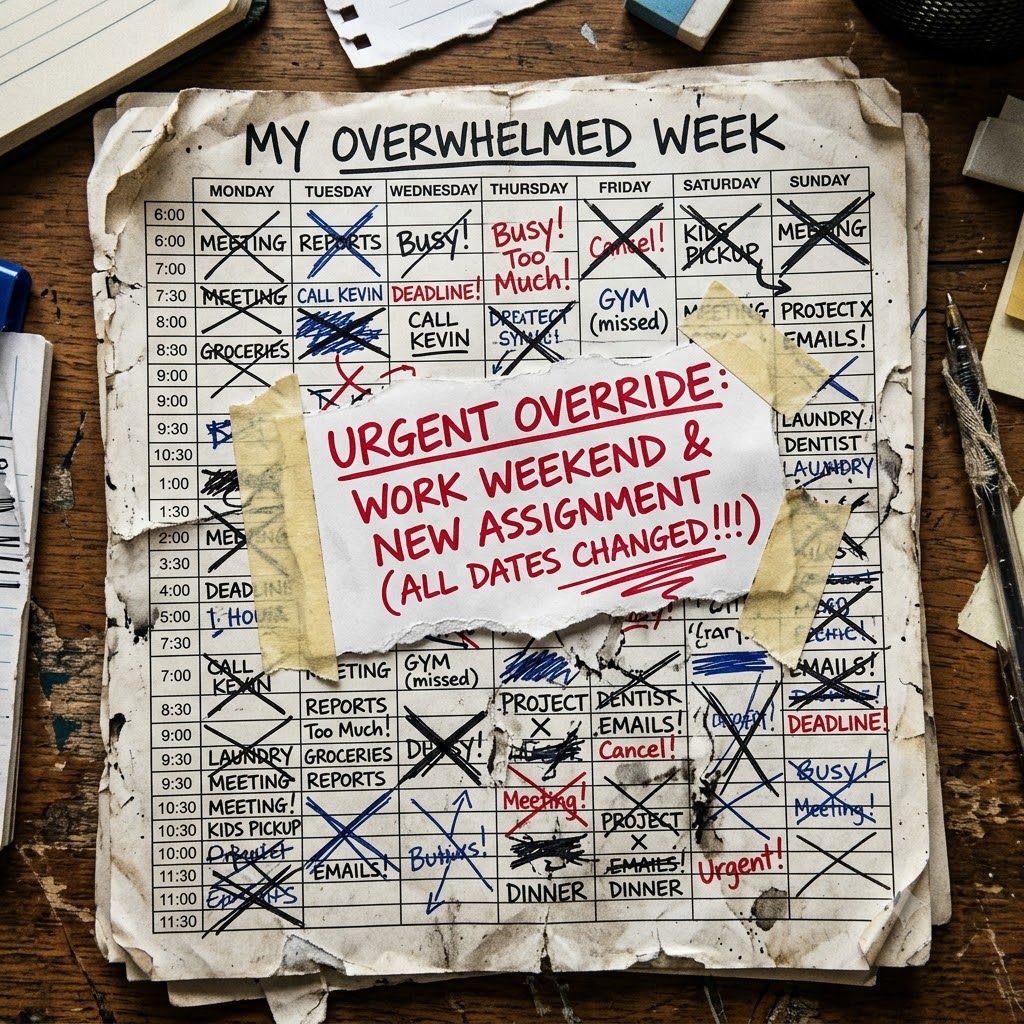
For most of my adult life, I treated sleep as optional. People talk about burning the candle at both ends. I wasn’t doing that. I was taking a blowtorch to it. Work, volunteering, teaching, family, community. I always believed I could squeeze, or what my wife calls my shoehorning, in one more thing, carry one more load, stay up one more hour. That week had pushed even me. I had been running on barely four hours of sleep a night, and still I never once considered slowing down.
My wife, Mellisa, was away for the weekend with friends, so it was just Nathan and me in the house.
The morning was crisp and bright, one of those perfect Wisconsin fall days that makes you want to throw open every window. I climbed out of bed and started my usual routine. I have a habit of making the bed before I do anything else, every single day. Our bedrooms are on the second floor, and I remember standing at the foot of the bed thinking how bone-tired I felt. Somewhere deep down, a small voice told me to climb back under the covers.
I ignored it.
That is my last memory.
The next thing I knew, a voice was tearing through the fog.
“Dad! Dad! DAAAAAD!”
I couldn’t tell where I was. Everything was blurred and dreamlike, the world smeared at the edges, my ears ringing like the day after a loud concert. Slowly, a face swam into focus above me. Nathan’s eyes were wide with terror. Something warm was running into my eyes, and I could taste copper. Blood. It was streaming down my forehead, and as my vision cleared, I understood, dimly, that I was lying crumpled at the bottom of our staircase.
“What happened?”
We only pieced it together later, and what we pieced together still unsettles me.
I had been so starved of sleep that I had fallen asleep on my feet. Not lain down. Not drifted off in a chair. My body finished the morning routine while my mind had already gone dark. Like some exhausted, hollow version of sleepwalking, I made the bed. I gathered an armful of clothes and carried them into the spare bedroom. Then I turned toward the stairs.
Still asleep.
Somewhere at the top of that staircase, my foot found empty air.
I went down the entire flight, from the second floor to the landing below. Hardwood stairs. Hardwood floor. Nothing to break the fall but the edge of every step.
Nathan was asleep in his room when the sound hit: the crash of his father’s body coming apart down the stairs. He bolted awake, ran into the hall, and found me sprawled at the bottom. Motionless. Bleeding from the head. Not answering.
I can only imagine what went through his mind in those seconds. I hope he never has to feel it again.
Here is the part I still can’t explain.
At the emergency room, the doctors confirmed what should not have been possible. A few stitches above my forehead. A small scar I still carry. And nothing else. No broken bones. No bleeding on the brain. No spinal injury. No internal damage. Nothing. The physicians were as stunned as I was. A fall down a full flight of hardwood stairs usually ends another way entirely. People do not simply stand up and walk out.
I did. I walked out with a scar and the unshakable sense that I had just been handed back a life I had nearly thrown away.
And one more detail I have never been able to account for. I remember almost nothing of the fall itself, but I do remember a strange, floating weightlessness, as though gravity had quietly switched off. It was peaceful. Almost gentle, like drifting underwater or surfacing slowly from anesthesia. That feeling lingered as the world reassembled around me. I can still summon it if I sit quietly.
To this day, I cannot explain it. I have simply learned to call it what it felt like: being carried.
What the Fall Did Not Fix
You would think a story like that ends with a changed man. That is how these stories are supposed to go. The near miss, the wake-up call, the new leaf.
Here is the truth. I slept more after that. I respected the physical limit I had found the hard way. But the engine underneath, the thing that had me running on four hours of sleep in the first place, kept right on running. I kept saying yes. Kept stacking commitments. Work, church, community boards, teaching, mediation, family. The candle was still lit at both ends. I had just upgraded the wax.
Because here is what I have learned, both in my own life and now in my training as a counselor: a crisis can stop your body cold, but it cannot answer the question your soul is asking. It only turns up the volume.
It took almost five more years, and one insightful classmate, before I heard the question stated plainly.
The Question
In the summer of 2025, I was sitting in my individual counseling course. If you have never been inside a counseling program, you should know these classrooms are unusual places. You cannot learn to sit with other people’s pain without your own rising to the surface. It is part occupational hazard, part gift.
At some point, I had rattled off my list. The graduate program. The teaching. The mediation work. The volunteering. The boards. The list I had always carried like a résumé and, if I am honest, like armor.
A classmate, one of those rare people who listens more deeply than anyone else in the room (and who is going to do great things in this field), looked at me and asked a simple question.
“Why do you feel the need to do so much?”
There was no judgment in it. No edge. That is exactly why it landed. It went past the schedule, past the calendar, past every practical answer I had ever given (opportunity, energy, calling, “I just love it”), straight down to the foundation.
Because underneath why do you do so much sits a much older question, and I knew it the moment the words landed. The real question was: Am I worthy? Do I believe I am enough if I stop producing? Would I still matter, standing still?
In counseling, we talk about the question underneath the question. This was mine. It had been mine for a very long time.
The Engine
I know where some of it comes from. Part of my drive is an old vow to prove my childhood wrong. I grew up with instability and wounds I am still writing my way through, and somewhere early, I concluded that if I just did enough, achieved enough, helped enough, I would outrun the story I was handed. And part of it, I admit, is a drive I cannot fully name. An engine that simply runs, that has always run, that I did not install and have never found the off switch for.
For decades, I treated that engine as pure virtue. Look at the output. Look at the service. Who could argue with fruit?
But doing as proof of worth is a debt that can never be retired. Every accomplishment buys you one day of feeling like enough, maybe two, and then the meter resets and you owe again. You are not living from worth. You are living for it. And the interest compounds: exhaustion, thinner margins, a wife who gets the leftovers of your attention, a body making the payments your calendar refuses to make.
Sometimes the body forecloses. Mine did, at the top of a staircase.
The Answer
So let me answer the question my classmate asked, the real one, plainly.
Am I worthy? Yes. I am.
Not because of the boards I have served on or the classes I have taught or the disputes I have mediated. Not because of anything on the list. As a Christian, I believe my worth was settled long before I did anything at all. It was declared, not earned. Received, not achieved. Grace, if it means anything, means the meter is not running. In my tradition, we speak of living coram Deo, before the face of God. You do not perform for that face. You live before it, already loved.
I believed all of that theologically for years. I could have taught the lesson. Believing it in your bones, standing bone-tired at the foot of your own bed, is a different thing entirely. That is the work I am doing now.
Wholeness, Not a Fuller Cup
The question also forced me to look hard at the self-care advice I had been giving and receiving for years. “Fill your cup.” Take the rest, the hobby, the vacation, and pour some energy back in.
I no longer think the cup is the right picture. I recently finished a long essay arguing exactly that, and the short version fits in a few lines. The cup model treats life as an energy ledger: two sips out, one sip in, hope it balances by Friday. But if you find yourself exhausted while actively practicing self-care (and I was), the problem is not your pouring technique. The problem is the metaphor. As long as you imagine yourself as a leaky vessel, the best you can ever be is less empty.
Wholeness asks a different question. Not what fills me? but what makes me whole? Not a vessel to top off, but a web of right relationships running across four arenas: your relationship with time (your past, your present, and the person you are becoming), with yourself (identity and body), with others (the people who truly know you, and the people placed in your care), and with what is greater than you (cause, God, legacy). Energy stops being a quantity to manage and becomes a gauge, telling you where those relationships are out of order.
When I ran my own life through that grid, the readings were hard to look at. My relationship with others was thriving in public and starving at home. My relationship with myself treated my body as a delivery system for my commitments. And my relationship with what is greater had quietly become a relationship with being needed. Being needed is a wonderful feeling and a terrible god.
What Changed
Here is what this looks like in practice, because wholeness that never touches the calendar is just vocabulary.
I chose not to run for the county board. I believe in that work, and part of me wanted the seat. But my counseling practicum needed the room, and I could not hold both faithfully. The old me would have found a way to do both badly. Saying no felt like a small death. It turned out to be a small resurrection.
I am prioritizing time with Mellisa. Not leftover time. First-fruits time. She has earned far better than the bottom of my energy gauge, and I am learning that presence is not what you give when the list is done. The list is never done.
I am taking more time to write and research, the work that integrates everything else I do instead of just adding to the pile. And I am giving real time to learning more about God. Not as another subject to master (old habits die hard), but as the relationship that holds every other relationship in place.
Notice what did not change. I still do a lot. I suspect I always will, and I have made peace with that. I still feel the pull to fit as much as I can into whatever time I am given before I am called to Heaven. But there is a difference, and it is the whole difference, between doing much to prove your worth and doing much because you are already whole and the life you have been handed is worth spending completely.
The first is a debt. The second is an overflow.
The Hardest Thing I Still Do
But I owe you one more confession, because everything above might leave the impression that I have this settled. The most difficult thing I do, even to this day, is stay in the present moment.
Not the calendar version of presence, where you show up to the thing you said you would attend. The real version. My mind races. In the middle of a conversation with someone I care about, I catch myself reaching for the next thing. How does this connect to that other project? What does this mean for tomorrow? Before I know it, I have moved into the future, drafting it, rehearsing it, solving it, while someone is handing me their present. The engine, it turns out, does not need a calendar to run. It will run on pure thought.
So I have had to learn how to ground myself in the moment, and I mean learn, the way you learn a language as an adult: slowly, with errors, with an accent I will probably always carry. Stilling my mind is not something that happens to me. It is something I practice.
It starts with the people around me. When I feel my mind lifting off, I anchor to the person in front of me. Their face. Their actual words, not the response I am composing. I remind myself that this person is not a stop on the way to the next thing. They are the thing.
It is a mix of mindfulness, too, though nothing exotic. I consider my surroundings and how I am interacting with them. What does this room sound like? I often think of music for the place I am standing in. If this ordinary Tuesday had a soundtrack, what would be playing? Just asking the question slows me down enough to hear the moment itself.
And I consider the wonders of God. Not the big theological ideas. I can turn those into another project in about four seconds (old habits, again). I mean the blessings of the particular environment I am in. Fall light through a window. The smell of coffee. Mellisa laughing in the next room. Small, particular blessings. Gratitude at ground level.
And when none of that works, and some days none of it does, I am called back to a hymn we sing in my tradition, “Be Still, My Soul” (847 in the Christian Worship hymnal). Be still, my soul; the Lord is on your side. What strikes me every time is who the hymn is addressed to. Not to God. To the soul. The singer is preaching to his own racing heart, telling it to sit down and be held. Some mornings, that is the whole discipline: singing to myself the words my mind refuses to say.
Because a racing mind is just the engine’s cleverest disguise. You can be doing too much entirely inside your own head, planning, connecting, moving into the future, even when the calendar swears you are resting. Presence, I am finding, is where the worth question actually gets answered. If I am already enough, then this moment is already enough. I do not have to leave it to go earn the next one.
Back to the Staircase
I think often about that floating feeling at the bottom of the stairs. The weightlessness I cannot explain. It is, to this day, the stillest my mind has ever been.
Here is what strikes me about it now. In the one moment of my adult life when I was doing absolutely nothing (no producing, no serving, no proving, unconscious and falling), I was, by every measure that matters, being held. I did not earn that landing. I could not have. I was asleep.
Maybe that is the plainest picture of grace I will ever be given: carried precisely when I could contribute nothing to the carrying.
So let me hand you my classmate’s question, the one that has done so much work in me. Why do you feel the need to do so much? Sit with it longer than is comfortable. And if the question underneath it turns out to be am I worthy, I hope you find what I am finding.
You are. You were before you did anything.
Now go live like it.
The ideas about wholeness in this post are drawn from my full essay, “Wholeness Is Not a Cup: An Essay on Self-Care, the Four Arenas, and the Coram Deo Life.”
 Life Vocations
Leave a comment