Stop Filling Your Cup
Why the most popular metaphor for self-care is quietly working against you
Adapted from the essay “Wholeness Is Not a Cup” by Bryan D. Stafford
You know the advice. You can’t pour from an empty cup. Fill your own cup first. Rest, recharge, take a bath, book the trip, protect your energy. It’s everywhere, and it isn’t wrong. Rest is real. Restoration matters. If you’re running yourself into the ground, the answer is not to run harder.
But here’s the thing almost nobody says out loud: the cup metaphor has a ceiling built into it, and that ceiling is lower than you think.
Picture what the metaphor actually claims. You are a container. The container holds a finite amount of stuff. Life drains it. Self-care tops it back up. Spend some, take some back, and hope the ledger balances by Friday. Two sips out, one sip in — and very little sense of how full the thing was to begin with.
Live inside that picture for a while and notice what it has already decided for you. If you’re a cup, then depletion is your baseline. The best you can ever hope for is less empty. You’re no longer pursuing health; you’re managing a slow leak. And the strangest symptom of all is the one many people quietly recognize: you can be disciplined about rest, conscientious about boundaries, religious about your self-care rituals — and still wake up exhausted. That contradiction isn’t a sign you’re doing it wrong. It’s the diagnosis.
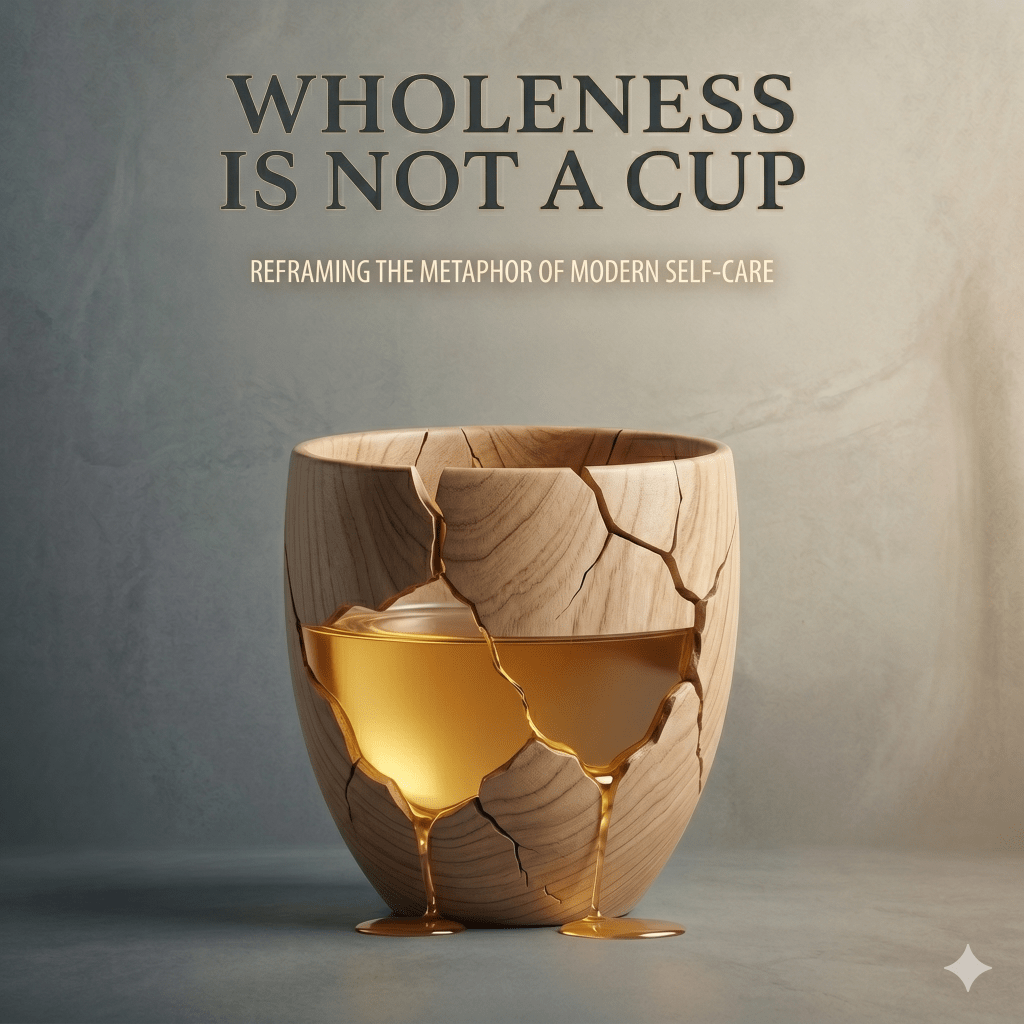
You can keep pouring water into a cracked cup and still feel empty.
When that happens, the instinct is almost always tactical. Pour faster. Pour better. Find activities that refill more efficiently. But the math was never the problem. The metaphor is. As long as you imagine yourself as a vessel that holds finite stuff and slowly leaks, you have already lost the most important argument before it starts.
The reframe: you were never a cup
Try changing the question. Instead of asking what fills me, ask what makes me whole?
That swap sounds small. It isn’t. It changes the entire architecture. Because the honest answer is that you are not a container at all. You are a web of relationships — and relationships don’t work like water in a cup. They are not drained by being lived. They are constituted by being lived. You don’t lose your friendship by spending time in it; the friendship is the time you spend. Right relationships don’t leak. They hold.
And “relationships” here means more than the people in your phone. It means your relationship with yourself — how you see, treat, and talk to the person you wake up to every morning. Your relationship with your own body. With your work and the people it serves. With your past, your present, and the future self you’re becoming. With whatever larger thing gives your days a direction. Less a set of ties to maintain, more like a river: always moving, always shaping the ground beneath it.
This isn’t a single thinker’s hunch. A surprising range of serious traditions converge on it. Alfred Adler argued the self is indivisible — nothing in a life gets fixed in isolation. Viktor Frankl, who survived the camps, insisted meaning is a direction you move toward, not a feeling you top off, and that we are most ourselves when we’re oriented beyond ourselves. Carl Rogers called health congruence: your sense of who you are, lining up with how you actually live. Marsha Linehan built an entire therapy around holding opposite truths together instead of letting one cancel the other. And long before any of them, the Hebrew word shalom named not the absence of trouble but the right ordering of a life. Wholeness as integrity, not as a full tank.
The self is not a vessel. It’s a web. It’s a river.
The four arenas of a whole life
If wholeness is really about the quality of your relationships, those relationships sort into four arenas. Think of them less as boxes to check and more as the rooms of a life you’re trying to keep on speaking terms with each other.
1. Your relationship with time
Past, present, and future aren’t three separate things. They’re one continuous line of meaning running through you, and wholeness means none of the three is cut off.
- Past: Are you carrying your formation, your wounds, your gratitude, and your unfinished grief without either denying them or being trapped by them? Can you fold them into a story that hangs together?
- Present: Can you actually live in your current life — honestly, awake — instead of constantly escaping it?
- Future: Is there a self you’re becoming? Does your direction have a shape that your present actions genuinely serve?
2. Your relationship with yourself
This is identity, but it has to include the body. The cup model is quietly disembodied; it treats you as a mind that happens to be carried around by some inconvenient hardware. The older wisdom pushes back hard: you are not a mind that has a body. You are an embodied person.
- Identity: Underneath the titles, the productivity, and the external validation — who do you actually believe you are? And does that match how you live?
- Body: Are you on speaking terms with your own physical existence? Or have you been treating your body as the delivery system for your “real” life?
3. Your relationship with others
Community, yes — but also vocation, in the old sense, not the LinkedIn sense. Vocation is the whole web of callings (spouse, parent, friend, neighbor, citizen, worker) through which your life actually serves other people. You don’t first become a self and then enter relationships; you become a self by entering them.
- Tribe: Are you truly known by anyone? Is there real reciprocity, accountability, and belonging — or just contacts?
- Vocation: Are you faithfully present to the specific people your life has placed in your care?
4. Your relationship with what is greater than you
We’re most fully ourselves when something pulls us out of self-absorption — a task, a person, a cause, a meaning bigger than our own comfort. You can have a cause without a spiritual framework, a spiritual life without a clear cause, or a strong sense of what you want to leave behind without naming either. Wholeness asks after all three.
- Cause: Is there a horizon of meaning you’re serving — something that pulls you beyond yourself?
- The spiritual: Is your life oriented toward something larger than you, or merely decorated by it?
- Legacy: What is your life for — and what of it continues when you can no longer carry it? Children, a body of work, or simply people whose lives are different because you were in them.
So where does energy come in?
Here’s the part that reframes the whole self-care conversation. Energy isn’t a fifth arena. It’s the gauge that reads across the other four.
When you feel chronically drained, the cup model tells you to refill. The four-arena model tells you to read the instrument. What is nourishing you, and what is quietly eroding you? Where do you get clarity, and where do you get fragmentation? Energy isn’t the thing to manage — it’s the warning light. A persistent leak is almost always leaking from somewhere specific: a relationship that’s out of order, a value you’ve stopped protecting, a tension in one of the four arenas that is fragmenting instead of integrating.
Energy doesn’t tell you to rest. It tells you where the work is.
That’s a genuinely different move. Stop trying to refill the cup. Ask instead whether your life is rightly ordered — whether the work, rest, relationships, and meaning that make up your days are doing what they were meant to do. And then let the cup-filling activities do what they were always meant to do: not stand in for wholeness, but serve it.
From idea to Tuesday morning: name what you’re protecting
Knowing the architecture is not the same as living in it. You can be eloquent about wholeness in the abstract and completely unprotected in the particular. So here’s the part you can actually do this week.
In each of the four arenas, name the values that orient you. Aim for ten to fifteen total — enough to be specific, few enough to defend. Write them down. Not goals you’ll check off, and not feelings you’re waiting to arrive, but directions you keep walking toward. Things like presence over productivity. Honesty between who you think you are and how you live. Faithfulness to the people you’ve promised to show up for. Treating your body as part of yourself, not as a tool.
Then do the harder second pass. Name what is not on the list — the things you’ve actually been chasing that you now realize don’t belong. For most of us these are the loudest items in the daily noise: status, approval, comfort, being right, being seen as the smart one, being needed. They’re not always bad. Often they’re ordinary goods that got quietly promoted to ultimate ones. But until you name them, you can’t defend against them. A value you can’t name is a value you can’t protect.
And protection is exactly the right word. Once you’ve named these values, you have to guard them, because nothing else will. The economy won’t. Your phone won’t. Your calendar, left to its own gravity, absolutely won’t. You keep watch: say no to what erodes them, say yes to what serves them, and let the rest fall.
Now — and only now — the question what fills my cup? comes back, in its right place. The walk in the woods isn’t emergency triage anymore; it serves your relationship with your body. Dinner with friends serves your tribe. An hour with a book serves your honest memory and your humility. Keeping a Sabbath, even with a full inbox, serves the thing you’re oriented toward. The question is no longer “what makes me feel better?” It’s “what concrete action serves the values I’ve named and have to protect?”
It is not glamorous work. It looks like saying no to good things in order to say yes to better ones. It looks like protecting one evening because that’s when you promised to be present. The actions are small. The cumulative effect, over the years, is a whole life.
What wholeness actually feels like
Wholeness is not perfection, and it’s not constant happiness, and it is definitely not a life free of pain or grief. The simplest way to say it: there is no longer a civil war inside you.
The arenas stop competing and start cohering. The past stops ambushing the present; the present stops hiding from the future. Identity and body get on speaking terms. You stop medicating disconnection with little hits of relief, and you stop confusing stimulation for fulfillment, escape for peace, pleasure for meaning, recovery for healing. Integration isn’t the absence of tension. It’s the productive synthesis of it — the right ordering of a life lived under difficulty.
And the cup activities don’t disappear. They’re transformed. They stop being life support — the precarious bet that the next refill arrives in time — and become something else entirely.
Not life support. Overflow.
A life of overflow is so structurally integrated, so rightly ordered, so well-protected, that what comes out of it is what has been put into it, with margin to spare. Energy stops being the measure of your day. Energy becomes what your day produces.
That’s the whole secular case, and it stands on its own. You don’t need any particular faith to use it. But for readers who come at life through a Christian lens, there’s one more layer — and it changes where the weight rests.
A Christian reading: wholeness lived before the face of God
Everything above is true on its own terms. But for the reader formed in a Christian — and especially a Reformation — tradition, the framework doesn’t stand on its own. It rests on a ground. And the ground has a name: coram Deo, life lived before the face of God.
To live coram Deo is to live the whole of your life — work, marriage, body, sleep, conflict, sorrow, joy, the most ordinary Tuesday morning — in the presence of God and under his gaze. Nothing bracketed out. Nothing private from him. In the secular frame, “the spiritual” sat as one strand inside the fourth arena. That’s honest in a pluralistic register, but for the Christian it’s structurally incomplete. The vertical axis isn’t one dimension among others. It runs through all four. Your relationship with your past is coram Deo. With your body, coram Deo. With your spouse, your work, your unfinished grief — each is already a vertical relationship before it’s a horizontal one, because the God before whom you stand is the one giving and ordering each calling.
The same four arenas, read vertically
The arenas don’t change shape under this reading. They deepen. Your relationship with time becomes a story God is still writing, with the present moment as the place you actually stand before him and the future as the shape of the sanctification he’s working in you. Your relationship with your body is grounded in the Incarnation — God himself took on a body, so yours is not a problem to transcend but already holy ground. Your relationship with others recovers the full Lutheran depth of vocation: the web of callings is the means through which God’s care for your neighbor flows through ordinary life. The milkmaid and the monk both serve God in their work, and the parent up at three in the morning is doing holy labor. And “what is greater than you” stops being a vague horizon and becomes a kingdom you’ve been folded into.
Values become discernment; off-list items become idols
The values exercise takes on a different character, too. In the secular frame, you choose your values. In the Christian frame, you mostly receive them — the work is closer to discernment than invention. The question shifts from ” What do I value? to ” What has God formed me to value, and where have I drifted?
And the off-list items get named more sharply. Status, approval, comfort, performance, being needed — these aren’t just goods that got over-promoted. They’re functional idols, and the first commandment names them as such: “You shall have no other gods before me.” Writing them down becomes, in the older language, the work of identifying which gods you’ve been quietly serving alongside the One you mean to serve. “Guard your heart, for from it flow the springs of life” stops being a nice aphorism and becomes operational instruction — with one crucial difference: the watch is not finally yours to keep alone. The same Spirit who shapes the values steadies the guard. The Sabbath isn’t a productivity hack; it’s the weekly enactment of the truth that you are kept by a faithfulness running underneath your own, by One who “neither slumbers nor sleeps.”
The theology of the cross, and the cup that runs over
This reading is allergic to triumphalism. The Christian life is not a smooth climb toward having it all together. The theology of the cross has always insisted that suffering be named honestly rather than explained away — integrated into the coram Deo life, not exempted from it. The peace that ends the civil war isn’t the absence of struggle; it’s the relocation of where you stand. No longer earning, no longer defending, no longer compensating — but held. Augustine named the exact restlessness the cup metaphor diagnoses, and located its cure outside the self entirely: “our hearts are restless until they rest in Thee.”
Which is why the cup metaphor finally finds its real resolution not in self-help but in Scripture — because Scripture got there first. The Psalmist wrote, “Thou anointest my head with oil; my cup runneth over.” The cup is real. The overflow is real. But the overflow is not the work of the one holding the cup. It’s the work of the One pouring into it.
The Christian doesn’t finally fill the cup. The Christian doesn’t even hold the cup. The Christian receives a life ordered from outside the self — and, slowly, learns to live inside it.
And what is poured in is meant to be poured back out: into your spouse, your children, your students, your neighbors, your work. The cup is not a closed system. It was never meant to be.
Something to walk away with
Here’s the one move worth making this week, whichever lens you read through. Stop asking what will refill me, and ask instead what makes me whole. Then get concrete: take ten minutes, divide a page into four — time, self, others, what’s greater than you — and write down what you actually value in each. Add the second list, the off-list one, of what you’ve been chasing that doesn’t belong. Pick one value that’s been quietly unprotected, and guard it tomorrow with a single, specific act.
You were never a cup, slowly leaking, one missed bath away from collapse. You’re a web of relationships, a river, a person being formed across four arenas by the very things that constitute you. Tend those well, protect what matters, and the small acts of self-care stop being triage and become what they were always meant to be.
Not life support. Overflow.
The full essay this post is drawn from — “Wholeness Is Not a Cup: An Essay on Self-Care, the Four Arenas, and the Coram Deo Life” by Bryan D. Stafford, with full citations and the complete theological treatment — follows below.


Responses
[…] it finds water by driving its roots downward. That is the direction of life — and the reason wholeness is never a cup to be filled (Wholeness Is Not a Cup), but a depth to be grown into. Down and in first, then up toward the […]
LikeLike
[…] ideas about wholeness in this post are drawn from my full essay, “Wholeness Is Not a Cup: An Essay on Self-Care, the Four Arenas, and the Coram Deo […]
LikeLike