The full essay can be found at https://lifevocation.blog/2026/06/04/the-soul-of-a-decision/
Pip: Life Vocations is a site that takes seriously the idea that how you decide shapes who you become — which is either a profound insight or a very long way of saying “choices matter.” Probably both.
Mara: Bryan D. Stafford is the writer behind everything we’re covering today, and the territory is rich: how human beings actually make decisions, and what gets missed when we treat choice as a purely rational exercise.
Pip: Let’s start with the soul of a decision itself — what it means to choose as a whole person, not just a calculating mind.
The Soul of a Decision
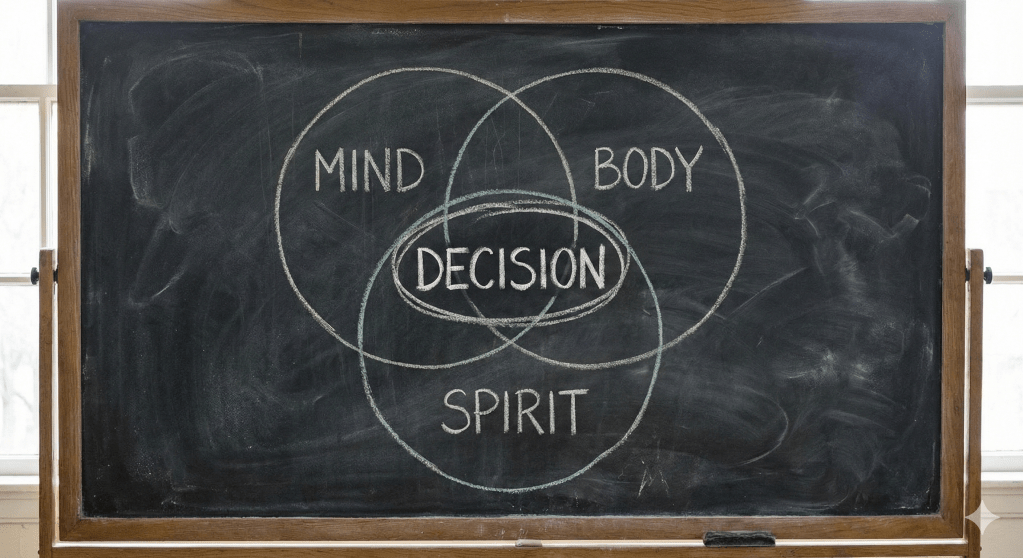
Mara: The central argument here is that the standard eight-step rational decision model — identify the problem, weigh criteria, evaluate alternatives, choose — is not wrong, but it is incomplete. Real decisions engage the whole person: mind, body, and spirit simultaneously.
Pip: And the paper names what that incompleteness costs. Bazerman and Tenbrunsel’s research gets cited directly on this point.
Mara: Right — the post quotes the central thesis directly: “A decision is a multi-faceted, living entity that cannot be adequately understood through any single theoretical lens. Real-world decision-making draws simultaneously from rational, emotional, moral, social, and meaning-centered frameworks — and these frameworks function as complementary lenses rather than competing explanations. The integration is the wisdom.”
Pip: So the rational model isn’t the enemy. It’s just one instrument in a larger ensemble that most people are playing without knowing the other instruments exist.
Mara: Exactly, and the framework names three dimensions that decisions always engage. The psychological layer — perception, memory, bias, Kahneman’s fast and slow systems. The physiological layer — Damasio’s somatic marker hypothesis, which shows that gut feelings actually narrow viable options before conscious analysis even begins. And the spiritual layer, which asks not just what to do but who is being asked to do it.
Pip: That third dimension is where the framework gets unusual. It draws on Frankl’s will to meaning, existential psychology, and Confessional Lutheran theology — vocation, law and gospel, the simultaneous reality of being both righteous and sinner. Not the typical management textbook chapter.
Mara: And it’s doing real work, not decoration. The Lutheran concept of simul justus et peccator — simultaneously righteous and sinner — addresses a practical problem: perfectionism paralyzes leaders. The paper puts it plainly: one decides as forgiven, which is exactly what makes it possible to decide at all.
Pip: There’s also a diagnostic case built around moral injury — what happens when the psychological, physiological, and spiritual dimensions fracture at once rather than integrate.
Mara: The repair vocabulary the paper offers is deliberately tri-dimensional: community, ritual, lament, witness, and reconnecting a wounded act to a larger story of meaning. Not therapy as an add-on to leadership, but as the mechanism that makes a long vocation sustainable.
Pip: The practical takeaways land the whole thing. Run the rational model — and run four discernment questions alongside it. Treat incongruence between analysis and body as information. Audit conscience before high-stakes decisions. And decide from grace, not toward it.
Mara: The closing image holds all of it together. Luther’s cobbler doesn’t put little crosses on shoes. The cobbler makes good shoes, and in that ordinary faithfulness, decision by decision, the neighbor is served.
Pip: Which means the question isn’t only how to decide well. It’s who you’re becoming as you decide — and that question doesn’t close when the meeting ends.
Mara: The through-line across all of this is that good decision-making is a practice of integration — rational analysis held together with embodied awareness, moral identity, and a sense of calling.
Pip: Next time we’ll see what else is taking shape at Life Vocations. The cobbler, apparently, keeps making shoes.


Leave a comment