Why the choices that keep you up at night are never just about the spreadsheet
Why the hardest choices keep you up at night even when you’d make them again—and what that ache is actually trying to tell you
There is a particular kind of decision that will not leave you alone. And here is the strange part: it isn’t the one you got wrong.
The one you got wrong, you can eventually make peace with. You learn the lesson, you apologize where an apology is owed, you resolve to do better. The guilt, however sharp, at least behaves itself. It has an object; it points somewhere. Guilt over a mistake is a clean emotion, and in time a clean emotion can be paid off.
I’m talking about the other kind.
The decision you would make again tomorrow, in exactly the same way, with all the same facts and all the same love, and that still sits on your chest at three in the morning like something you have to answer for. You’re not replaying it because you think you chose wrong. You know you didn’t. You’ve checked, and checked again, and the verdict never changes. You’re replaying it because it cost you something you can’t quite name—and the not-naming is its own quiet torment.
I spent a long time assuming that ache was a private failure—a sign that some weaker part of me hadn’t caught up with the logic yet, and that if I were a little tougher I’d be able to close the file and drive home into the weekend like everyone else seemed to.
It took me the better part of my life to understand that I had it exactly backwards. That ache is not a defect in the decider. It’s one of the most honest things a conscience can do. And it has a name.
The name almost no one gives it
The name comes, of all places, from the study of soldiers.
For years, clinicians who worked with veterans noticed a wound that didn’t fit the usual map. It wasn’t classic post-traumatic stress, which is built on fear—the body convinced its life is still in danger, flinching at a slammed door years after the war ended. This was something else. The predominant emotion wasn’t terror. It was shame. Guilt. A sense of betrayal, and underneath it all, the slow collapse of meaning.
They called it moral injury: the lasting harm that follows from doing—or failing to prevent, or simply witnessing—something that violates your own deepest moral commitments.
Read that definition slowly, because the whole point is hiding in the last clause. Moral injury is not the wound of having your values assaulted from the outside. It’s the wound of having acted against your own. Ordinary trauma says: something threatened me. Moral injury says: I became someone I didn’t want to be. The reassurances that soothe fear don’t touch it, because the accusation isn’t coming from the enemy across the field. It’s coming from inside the house.
And here is what the military framing can hide from us: you do not have to have gone to war to carry it.
It shows up constantly in ordinary life, in the quiet, unspectacular decisions that wound even when they’re right. The layoff that was genuinely the correct call for the business and still ended a good person’s livelihood. The loyal employee passed over for the promotion he’d earned by every human measure but one. The partnership you had to dissolve, the supplier you’d known for a decade and had to let go, the friend you suddenly had to manage as a subordinate. None of these would make a headline. Each of them was, on the evidence, correct. And a great many conscientious, capable people are walking around with the residue of decisions exactly like these—with no word for what they feel and no permission to feel it.
Because that’s the trap, isn’t it? The decision was right. So who are you to grieve a choice you’d make again? The very correctness of the call becomes the reason you’re forbidden to mourn it. And so you don’t say anything, and the silence lets the wound quietly fester.
We got a large, painful public lesson in this recently. During the pandemic, clinicians who had trained their whole lives to treat every patient as infinitely valuable were forced—by scarcity, not by anyone’s wrongdoing—into decisions that betrayed that commitment daily: rationed beds, families kept from dying loved ones by rules the staff themselves had to enforce, care delivered so far below the standard they believed in that it stopped feeling like care at all. Researchers watching the toll warned early that the signature wound of that workforce wouldn’t be burnout. It would be moral injury. And the distinction matters, because the two call for opposite treatments. Burnout says: reduce the load, add some recovery time. Moral injury says: the load was never the problem. The violation is. No amount of wellness programming touches a violated conscience.
The turn that changes everything
So far this may sound like a diagnosis of despair. Stay with me, because it’s actually a door swinging open.
For most of my life I carried a quiet, corrosive belief—one I suspect a lot of responsible people carry without ever saying it out loud: that a good enough person, following the right principles carefully enough, could move through the world without ever incurring real guilt. That clean hands were available, if only I were wise enough to keep mine clean.
A theologian named Dietrich Bonhoeffer, thinking about moral action in the darkest circumstances imaginable, said no. Flatly, no. To act responsibly for other people in a real, compromised situation is to accept that you may incur genuine cost even in doing exactly what love requires. There is no principle you can hide behind that guarantees innocence. And—this is the part that undid me—the attempt to find one, the refusal to act until you’re sure your hands will stay clean, is itself a failure. It’s a way of protecting your own innocence while your neighbor goes unserved.
Sit with what that means for the ache we’ve been describing.
The wound left by a right decision is not evidence that you chose badly. It is evidence that you are a responsible person who acted in a real world where a clean choice was never actually on offer. The ache is not a verdict against you. In a strange and almost unbearable way, it’s a mark of your integrity—the honest cost a person of conscience pays for refusing to stay safely on the sidelines, where the hands stay clean and the neighbor stays unhelped.
I find enormous relief in that, and I think you might too, whatever you believe. It reframes the whole exhausting project. The goal was never to find the choice that costs nothing. That choice does not exist, and hunting for it just keeps you frozen at the fork while the window closes. The goal is to choose the cost you can live with—and then to carry that cost as what it is, a wound and not a crime.
Why this is only half the picture
Here’s where I have to be honest with you: everything I’ve just described is one thread pulled from something much larger, and pulling it loose has been the work of the last few years of my life.
Because if a right decision can wound you, then something is happening in a decision that the textbook never told us about. The clean model I was trained on—identify the problem, weigh your options, pick the best one, implement, evaluate—describes a decision the way an anatomy chart describes a person. Accurate, useful, and somehow missing the entire point. It treats a choice as a bounded event: the moment the meeting ends, the decision is over.
Real decisions are nothing like that. They spill over their banks. They land on people who were never in the room. They go on living for years after the receipt prints. And—this is the thing I keep circling back to—they change the person who makes them.
A decision, I’ve come to believe, is not merely something you make. It is something that makes you. Every significant choice is quietly doing three things at once: it’s an act of choosing, yes, but it’s also an act of becoming—you are, by a small increment, a different person on the far side of it—and an act of serving, reaching into lives you can see and lives you never will. Most of us were only ever taught to hear the first. We were trained to ask, What’s the right decision? and to grade ourselves on the answer. Underneath that question, every consequential choice is asking a second one, quieter and far more important: Who am I becoming as I decide this, and whom am I serving as I do?
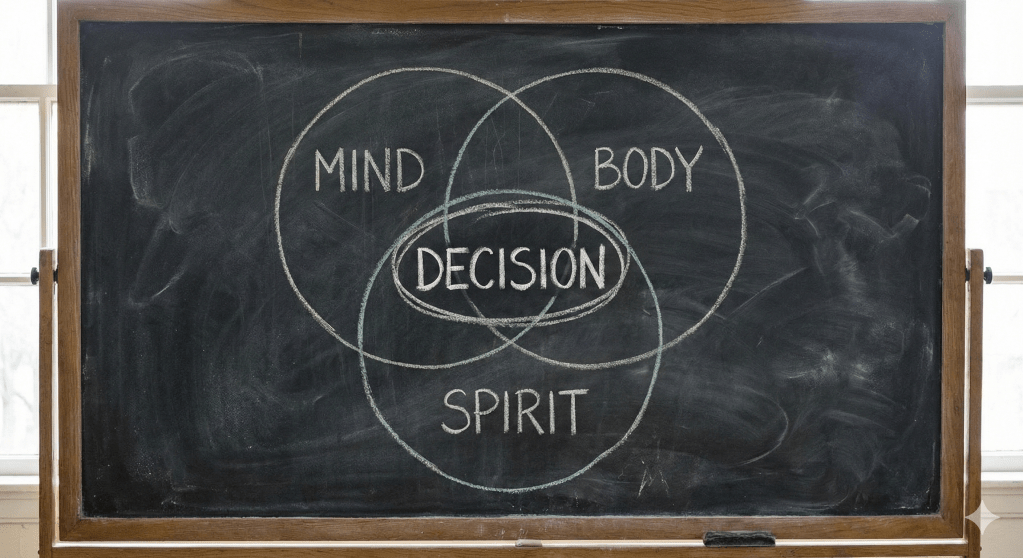
Once you can hear that second question, moral injury stops being a mystery. Of course a right decision can wound you. If your choices are steadily forming the person you’re turning into, then a choice that forces you to act against something sacred in yourself—the caregiver who has to agree to stop caregiving, the protector who has to sign off on letting go—doesn’t just produce an outcome. It puts a crack in the story of who you are. And it fractures you across every dimension at once: the reasoning mind that can’t file the act away, the body that keeps the score in your shoulders and your sleepless small hours, and the deep, meaning-seeking part of you that suddenly can’t feel your life still adds up. That total quality—feeling wrong all the way through rather than in one locatable spot—is the fingerprint of it. And recognizing it is the beginning of relief, because a wound you can finally name is a wound you can begin to tend.
I’ll say only a little here about tending it, because it deserves more room than a single essay can give. But the first two moves are almost embarrassingly simple, and almost no one makes them. The first is truthful naming: you refuse to minimize, refuse to spiritualize the harm away, refuse to bury it under the fact that the call was correct. You say the true thing plainly, even just to yourself: this was right, and it wounded me, and I will not pretend it didn’t. The second is refusing to carry it alone. Shame’s entire strategy is isolation—it whispers that if anyone knew, they’d see the taint you see—and telling the story to one person who can hear it without flinching breaks that strategy like nothing else. It is not weakness to need a witness. It’s how the wound begins to close.
Where I’m going with all this
I’m writing a book about the parts of deciding that the spreadsheet can’t hold. About why the most responsible people lose the most sleep, why the perfect decision you’ve been hunting for doesn’t exist, and why every choice you make is quietly casting a vote for the person who’ll make the next one. Moral injury is one chapter of that story—the one about the decisions that are right and hurt you anyway—but it opens, as these things do, onto the whole of it: the four hidden forces working on every real choice, the place where mind and body and spirit finally meet, and a handful of questions you can carry across any hard threshold.
I don’t have all of it worked out—which is part of why I’m writing here as much as writing the book, to think out loud in the company of people who take these questions as seriously as I do. So if you’ve ever made a decision you’d make again and still can’t quite set down, sit with one question before you go: what is that ache actually asking of you—not to unmake the choice, but to finally give it a name?
If any of this lands, come walk the rest of the road with me. I’ll be writing my way toward the book right here, one idea at a time. Subscribe, and I’ll make sure the next piece finds you—and you’ll be first to know when the book itself is ready.
The shoes are not going to make themselves. Let’s begin.
This post distills a longer scholarly paper, “The Soul of a Decision: An Integrated Framework for Understanding Human Choice,” which develops these ideas in full and includes complete references and citations. The full paper is available at the end of this blog entry.


Responses
[…] The full essay can be found at https://lifevocation.blog/2026/06/04/the-soul-of-a-decision/ […]
LikeLike
[…] unraveling, no long illness, no warning I was ever told about. It was instant; in an instant. A decision, a sound, and then a family that would never be the same. Five children and a widow, and the baby […]
LikeLike