Childlike Trust and the Wisdom That Exceeds My Own
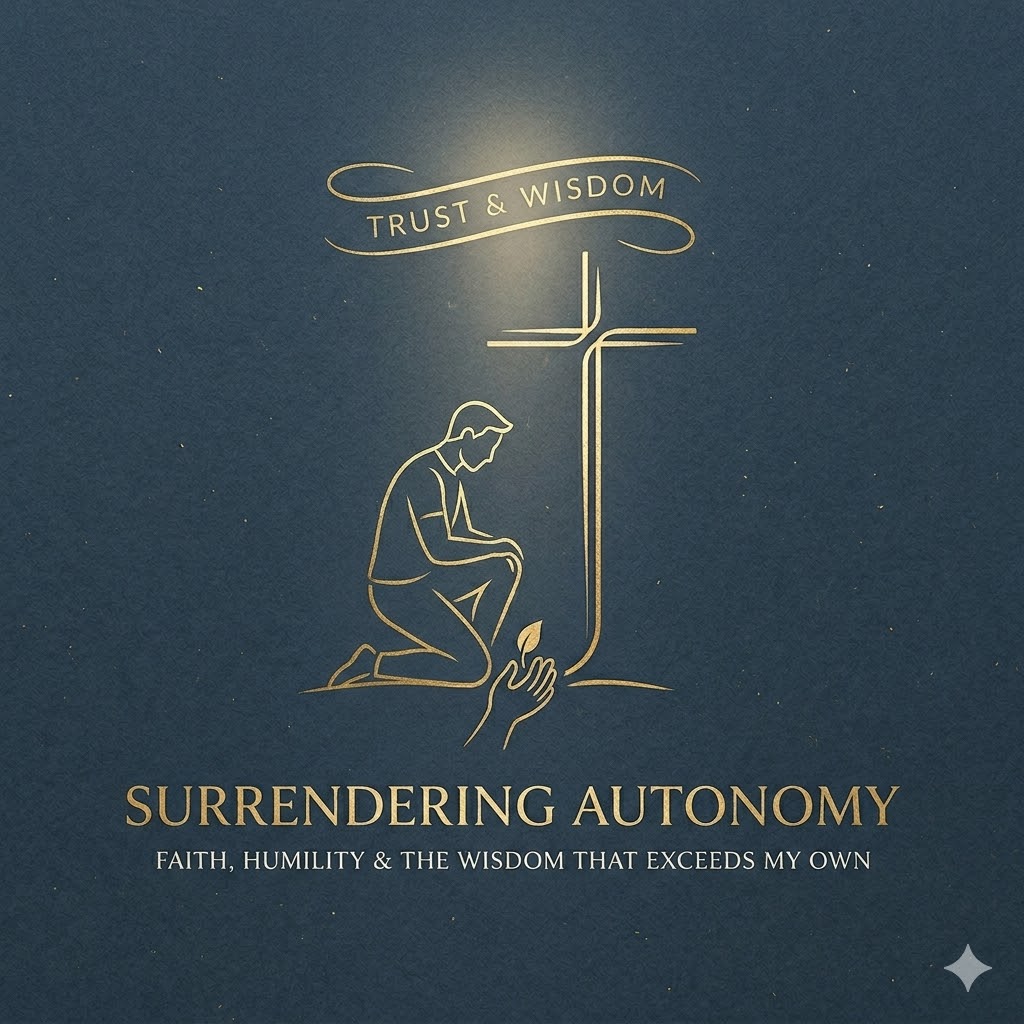
One of the hardest teachings of Scripture for me is the call to surrender autonomy. It asks me to accept that I am a creature who cannot, and was never meant to, understand all things as God does. I notice the resistance in myself most clearly when I am handed a problem without a clean solution: a relationship that will not resolve, a loss without an explanation, a doctrine that refuses to flatten into something I can fully manage. My instinct in those moments is not unbelief so much as a quiet insistence that if I could only gather enough information, reason carefully enough, and arrange the pieces correctly, I would finally be at rest. Scripture gently and persistently tells me otherwise. The deepest struggle is not ignorance; it is the desire to stand where only God belongs. Here is the main point I have missed all these years: true wisdom is listening to God’s word, and it is the only way to life. Not listening to God is a path to death.
The Garden and the Desire to Be Like God
The pattern begins in Eden. The serpent’s appeal in Genesis 3 is not crude; it is aspirational and epistemological. The promise is that the eyes of the man and woman would be opened and that they would become “like God, knowing good and evil” (Genesis 3:5). What is offered is not pleasure first but knowledge. It is a wisdom seized rather than received, a vantage point from which the creature could finally judge for himself what is good. The tree was, after all, desirable for gaining wisdom, and that is precisely what makes the temptation so recognizable. I rarely covet anything as obviously wrong as the serpent’s lie sounds when stated plainly. I covet competence. I covet the position of the one who sees the whole board and needs no one to explain it to him.
This is what makes the first sin more than disobedience. It is a reach for autonomy in the most literal sense of the word: self-law, self-rule, the determination to be the source of one’s own definitions. Adam and Eve did not merely break a command; they attempted to relocate the center of reality from God to themselves. And the tragedy is that the very thing they grasped at, namely, wisdom, openness, and sight, is something God delights to give His children freely, in His own way and time, on the far side of trust.
Knowledge, Shame, and Separation
What strikes me most about the account is what follows immediately. The eyes that were opened did not behold glory; they beheld nakedness. “Then the eyes of both of them were opened” (Genesis 3:7), and the first fruit of their new, autonomous knowing was shame, followed by hiding and fear. The sequence is instructive. Knowledge pursued apart from trust did not produce freedom; it produced exposure and estrangement. They covered themselves and withdrew from the One who had only ever walked with them in love.
I recognize that movement in my own life. When I treat understanding as the precondition for peace, the knowledge I accumulate rarely settles me. More often, it multiplies the things I feel responsible for controlling and the angles from which I feel exposed. Shame and self-protection are the native climate of the self that insists on standing alone. The lie promised that autonomous knowledge would make us more like God; in practice, it made us hide from Him. Separation, not mastery, is what the reach for autonomy actually delivers.
The Call Back to Childlike Trust
Against this backdrop, the consistent counter-call of Scripture is a return to dependence. Proverbs frames it plainly: ” Trust in the Lord with all your heart and ‘lean not on your own understanding” (Proverbs 3:5-6). Importantly, the issue here is not intelligence. Proverbs is itself a book of hard-won wisdom; it does not despise the mind. The danger it names is subtler. It is the moment when my own understanding becomes ultimate, the final court of appeal to which even God must submit His case. Reason is meant to lean; sin teaches it to stand alone.
Jesus presses the same point in still more striking terms. When the disciples ask who is greatest in the kingdom, He sets a child before them and says that unless they change and “become like little children,” they will never enter it (Matthew 18:1-4). This is not a call to be childish or credulous. The child He commends is marked by dependence, openness, and the simple willingness to receive, the very posture Eden rejected. A small child does not need to comprehend the household budget, the family’s medical decisions, or the reasons behind a parent’s no in order to rest securely. Trust precedes comprehension, and the child is none the worse for it. Childlike faith, then, is not the abandonment of reason but its right ordering: the creature at rest in the care of the Creator.
A Wisdom That Exceeds My Own
Much of my resistance dissolves the moment I take the sheer distance between God’s knowledge and mine seriously. Isaiah records the Lord’s reminder that “my thoughts are not your thoughts”, and that as the heavens are higher than the earth, so are His ways higher than ours (Isaiah 55:8-9). This is not meant to shame the believer into silence but to relocate him. It reminds him that faith has never required exhaustive understanding, because the object of faith is infinitely greater than the one who believes.
Job learns this in the most personal way. Having demanded an accounting from God, he is finally answered not with explanations but with a question: “Where were you when I laid the earth’s foundation?” (Job 38:4). God offers Job perspective rather than data, and remarkably, it is enough. Job’s restless need to know why gives way to a settled willingness to trust the One who does. Paul reaches a similar terminus at the close of his great argument in Romans, breaking into doxology rather than mastery: “Oh, the depth of the riches of the wisdom and knowledge of God!” (Romans 11:33). Theology, done rightly, ends in wonder.
Even now, Paul admits, “we see only a reflection as in a mirror” (1 Corinthians 13:12); our knowing is genuine but partial, awaiting a clarity we do not yet possess. The Preacher of Ecclesiastes says the same from another angle, observing that no one can fathom what God has done from beginning to end (Ecclesiastes 3:11). I am a finite creature standing before an infinite God, and Christian maturity, far from resenting that limit, learns to receive it as mercy. To be small before God is not a defect to be overcome; it is the truth of what I am.
Lutheran Insights on Surrender and Mystery
The Lutheran tradition has given me language for all of this. It begins by honoring reason rightly: reason is a gift of God, but a servant rather than a master. It does excellent work beneath Scripture and goes badly wrong the moment it tries to climb above it. Faith finally trusts God even where comprehension runs out. This is not anti-intellectualism; it is the recovery of reason’s proper vocation.
Luther named the underlying problem with unsettling clarity. Fallen humanity is in bondage, and the will it most stubbornly defends is precisely its claim to self-rule. Salvation, then, is not the perfecting of autonomy but its surrender, the relinquishing of the desire to be God in my own life. The tradition’s memorable phrase for the sinful condition is incurvatus in se, the self curved inward: bent away from dependence on God and folded back upon its own self-sufficiency and self-definition. That phrase describes my temptation with autonomy more accurately than any I have found.
Two further Lutheran emphases steady me where mystery remains. The first is the theology of the cross, the recognition that God characteristically works through weakness, hiddenness, and suffering rather than through the displays of power and control I would prefer. The God who saves does so on a cross, which is the last place autonomous wisdom would think to look. The second is the confession of the hidden God, the Deus absconditus, which is the acknowledgment that some of God’s ways remain genuinely beyond me. Faith does not pretend the mystery away; it trusts God inside it, clinging not to what is hidden but to what He has revealed and promised in Christ.
Underneath all of it lies the most basic confession of all, the First Article of the Creed: God is Creator, and I am a creature. I receive my life, my breath, my reason, and my meaning from Him; I do not generate them. Once that order is rightly named, the demand for autonomy is revealed for what it is. It is not a dignity to be defended but a confusion about who I actually am.
Freedom in Trust
What I once feared as loss, then, turns out to be the doorway to rest. I had assumed that freedom lay in mastering reality, in finally knowing enough to be secure. Scripture insists on the reverse. Freedom is found in trusting the God who already holds the reality I cannot master. The child at rest in a father’s arms is freer than the one who refuses to be carried until he understands the route.
This does not mean I stop thinking, studying, or seeking understanding; the God who gave reason is glad to be sought with it. It means I stop making an understanding of the condition of my peace. I can hold my questions, and I have many, within a deeper and prior trust, confident that the One whose thoughts are higher than mine is also the One who gave His Son for me. The same God who will not always explain Himself has already shown Himself entirely trustworthy at the cross. And so the hardest teaching becomes, strangely, the most freeing: I was never meant to stand where only God belongs, and I am finally at rest only when I stop trying. Faith is not grounded in autonomous understanding, but in childlike trust in the wisdom and promises of God.

 Life Vocations
Leave a comment