
By Bryan Stafford
There is a sickness moving through American life, and the strangest thing about it is how little noise it makes. You will not catch it on the evening news. It will not show up in your feed, wedged between a political argument and a video of somebody’s lunch. It does not arrive the way a virus or a war arrives, with sirens and headlines and a name everybody learns to fear. It is quiet. And I have come to believe that its quietness is exactly what makes it so dangerous.
I am talking about loneliness. Not the ordinary kind that passes when a friend calls, but the deep, structural kind that has settled into the bones of a whole society. In 2023, the U.S. Surgeon General declared loneliness and isolation a national epidemic, warning that the health damage from chronic disconnection rivals the damage from smoking (Office of the U.S. Surgeon General, 2023). Read that again. We have a public health crisis on the scale of cigarettes, and most of us have never thought to worry about it.
Here is the part that should stop us cold. We are lonelier than ever at the precise moment we are more connected than ever. We carry humanity’s recorded knowledge in our pockets and can reach almost anyone, anywhere, in seconds. By every measure of contact, this should be the least isolated generation in history. Instead, depression is climbing to record highs, and the people climbing fastest are the young (Gallup, 2023).
That is the paradox I want to sit with you and untangle. And I think it comes down to a single word that we have quietly redefined without noticing.
We Keep Confusing Two Very Different Things
The word is connection. We use it constantly. The platforms build it into their mission statements. We tell ourselves we are “staying connected” when we scroll a feed, fire off a text, drop a thumbs-up on a photo, or watch the same show everyone else is watching.
That is not a connection. That is interaction; we are only occupying the same space physically or virtually. And the difference between the two is the whole ballgame.
Interaction is contact without exposure. Think of the table where everyone is present, heads bent over their devices. It is the trade of signals without the vulnerability that real closeness demands. Sharing a room counts as interaction. So does liking a post. Neither requires you to be known. You can interact with hundreds of people in a single day and never once be truly seen by any of them. Most of our tools are built for exactly that outcome: maximum contact, minimum exposure. Even a lively group conversation is no guarantee. You can spend an hour volleying the conversational football back and forth, everyone touching it, no one holding it, and walk away having revealed nothing.
Now consider what has happened to another single word: friend.
Twenty-five years ago, a friend was a person who knew you. Not knew of you; actually knew you. Someone who had seen you at your worst and stayed. Someone who would help you move, sit with you in a hospital waiting room, tell you the truth when a stranger would have flattered you. The word was earned slowly, over years, through shared trouble and kept confidences. Most people could count their friends on one hand, and no one thought that was a failure. It was the point. The smallness of the number was the measure of its weight.
Then, in 2002, Friendster turned the noun into a feature. Facebook turned it into a verb. “Friending” someone became a single click, an act requiring no history, no risk, no obligation; nothing but a tap of the thumb. Friend counts climbed into the hundreds, then the thousands, and the platforms learned to display the number like a score. The hookup and dating apps completed the job, borrowing the whole vocabulary of intimacy — matches, connections, friends with benefits — to describe encounters engineered to require none of it.
This is semantic inflation, and it works like the monetary kind: print enough of a currency and every note is worth less. When “friend” can mean a stranger who once liked your photo, the word no longer has a way to mean the person who would drive through the night for you. We did not just dilute a term. We lost the language for the very thing we are starving for, and it is hard to ask for something you can no longer name.
There is a deeper problem hiding beneath the surface. When we interact through a screen, we are rarely meeting another actual person. We are meeting a performance. Each of us posts the curated, idealized version, the highlight reel, not the footage, and the people on the other end do the very same thing. Two polished, imaginary selves meet in the middle and exchange pleasantries, while neither real human being is ever quite in the room. We are interacting with the mask, and the mask is interacting back.
That is more corrosive than it first appears. It is not just that the contact is thin. It is that every exchange quietly teaches us a lesson: the real self — the anxious, uncertain, unfinished self — is not fit for company. So we get better and better at being liked, and worse and worse at being known. And being known, in the end, is the only thing that actually relieves loneliness.
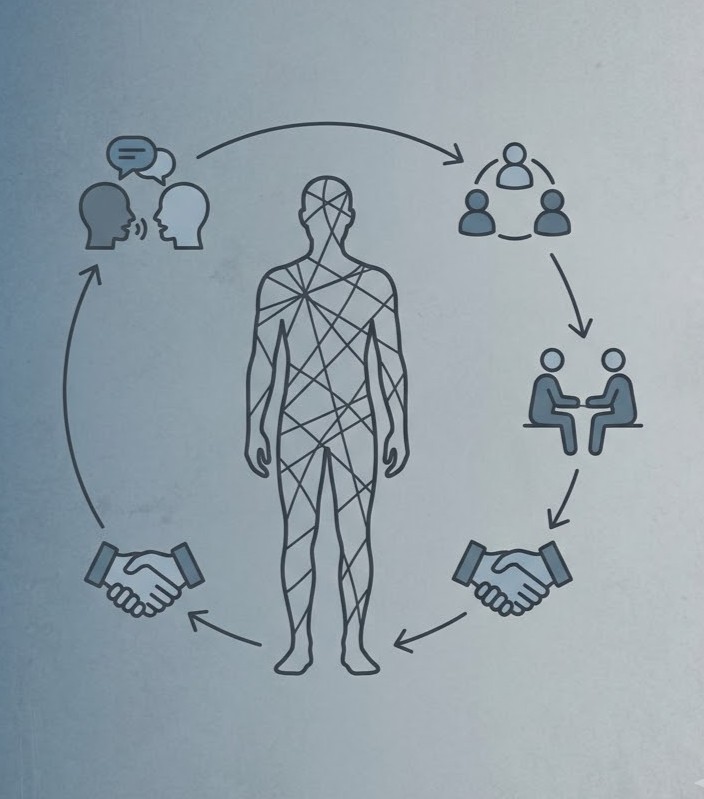
Think of human closeness as a staircase. At the bottom sits bare interaction: a like, a notification, a nod on a crowded train. A step up is communication, where meaning is actually exchanged. Above that is shared activity, then acquaintance, then friendship, the old, weight-bearing kind, then belonging, and at the very top, companionship. For most of human history, each step was a doorway to the next. You bumped into the same people at church or the bowling league; casual contact ripened into friendship, and enough friendships in one place produced a sense of belonging.
The modern environment breaks the staircase. It hands us an endless supply of the bottom step and quietly removes the doorways to the higher ones. We accumulate contacts that never deepen, because the places that used to carry a relationship upward, the long-held job, the congregation, the front porch, have themselves thinned out. So a person can send hundreds of messages in a day, hold a thousand “friends” in their pocket, and end the night with no one to sit beside. That is how a loneliness epidemic can live comfortably inside a flood of communication. The flood is part of what is drowning us.
The Misdiagnosis
Here is where it gets genuinely tragic. Almost nobody experiences this shortage in the right terms.
We feel the ache plainly enough. But we misread it. Ask people what they are missing and they will say more connection, more followers, more engagement, more something to fill the empty evening. They reach, in other words, for the very thing they already have too much of. And the more they reach, the hungrier they get.
There is a reason for the mistake, and it is not stupidity. Loneliness is not a character flaw or a passing mood. It is a biological signal, as old and urgent as hunger or thirst, and it evolved to drive a deeply social animal back toward the group it needs to survive (Cacioppo & Patrick, 2008). The brain takes it seriously. When we are rejected, the same circuitry that registers physical pain lights up, which is why being left out genuinely hurts (Eisenberger, 2012). But a signal can tell you something is wrong without telling you the cure. Hunger does not distinguish between a real meal and empty calories. It just insists that you eat. Loneliness is the same. It announces a deficit and leaves you to grab whatever is nearest that resembles what you crave.
Now look at what the modern environment places nearest. You come home to an empty apartment and feel the weight of an evening with nobody in it. The easy move is not to call a friend, which takes effort and might fail. It is to open the feed, where a thousand faces and a flicker of affection are already waiting, free of risk, and to scroll, maybe post something, and watch the little approvals arrive. For a while, the heaviness lifts, which is exactly the trap, because the lifting seems to confirm that more interaction was what you needed. An hour later, it returns, often heavier. Multiply that across a population and across years, and you have the central pathology of our age: a hunger reliably fed with the one food that cannot nourish it, by people who are not foolish, just responding rationally to the options in front of them.
That is the misdiagnosis of loneliness. We try to fill a companionship-shaped hole with interaction-shaped filler, and because the filler never reaches the cavity, the emptiness stays, and the appetite grows. Naming the need correctly is not a word game. It is the first move of any real cure. A person who thinks they need more connection will buy a louder phone. A person who understands that they need companionship will do the harder, rarer thing: let themselves be known by someone who stays.
What We Actually Need Is Companionship
So let me say plainly what I believe is missing underneath all the rest.
It isn’t contact. It isn’t interaction. It isn’t even friendship in the casual sense. It’s companionship — doing life with people. Not occupying the same room, not trading pleasant conversation, but sharing the unscripted, unremarkable middle of things. Anything less is just watching each other’s lives like a reality TV show: present, tuned in, and completely uninvolved.
Companionship, in its truest form, is a strong and authentic bond that gives a person’s life meaning. It is the difference between being surrounded and being accompanied. A companion is someone in whose presence you do not have to perform, someone who has seen the unedited footage and stayed. It is not a quantity of contacts but a quality of presence: being accompanied through life by people who know you, who would notice your absence, and to whom you are obligated in return.
We do not have to take this on faith. The Harvard Study of Adult Development has followed the same people for more than eighty years, and its headline finding is stubbornly simple. The single best predictor of who would grow into a healthy, happy old age was not wealth, cholesterol, or IQ. It was the quality of a person’s close relationships in midlife (Waldinger & Schulz, 2023). What protected people was not the size of their network but the presence of a few warm, dependable bonds. What the lonely lack is not stimulation, of which the world offers an endless supply, but secure attachment, of which it offers strikingly little.
The researcher Sherry Turkle gave the condition its perfect name more than a decade ago: “alone together.” We are tethered to devices that promise companionship while delivering connection stripped of its demands, its risks, and its rewards (Turkle, 2011). And that promise is seductive precisely because real companionship is costly. To be accompanied is to be inconvenienced. To be known is to be vulnerable. To belong is to be obligated. Interaction asks none of that. The trouble is that the very things we do to dodge the discomfort of closeness are the things that keep it from ever deepening.
A small note of consideration for those of us who share a Christian worldview: none of this should come as a surprise. The very first thing in the creation account declared not good was not sin or suffering; it was solitude. “It is not good for the man to be alone” (Genesis 2:18). Ecclesiastes says it with the bluntness of lived experience: “Two are better than one… pity anyone who falls and has no one to help them up” (4:9–10). And Jesus himself, who needed nothing, chose twelve companions, called them friends rather than servants (John 15:15), and in Gethsemane asked only that his closest ones stay near. Scripture does not treat companionship as a lifestyle preference or a personality trait. It treats it as a design specification, and it treats isolation as something to be remedied, not managed. If we are made in the image of a God who exists in eternal fellowship, then to be accompanied is not an accessory to human life. It is the shape of it.
The Three Soils
If companionship is what we need, the obvious next question is where it grows. I have come to think it takes root in three soils, three distinct bonds that together accomplish what no amount of connection ever can.
The first is the bond with another person. The spouse, the closest friend, the one who knows your history and your habits and chooses you anyway. It is built not by the volume of interaction but by faithfulness over time, by showing up in the ordinary moments nobody posts about. It asks for exactly what our screens train us to avoid: the willingness to take off the mask and discover that we are loved not despite our real selves, but as our real selves. One such bond is worth more than a thousand followers.
The second is the bond of family, the one we are born or adopted into, and the one we go on to build. Family is where most of us first learn whether the world is a place where we can be known and still be safe. When those ties are strong, they are a kind of ballast that steadies us through everything else. When they fray, by distance, by busyness, by the slow erosion of presence into mere logistics, the loss feels like a homelessness of the heart, even under a perfectly good roof. A great deal of modern loneliness, I suspect, is family bonds that were allowed to thin into interaction.
The third, and in many ways the deepest, is the bond with a higher power. There is a form of companionship that no human relationship can finally supply, a sense of being known and held by something larger than yourself, of belonging to an order of meaning that does not rise or fall with your performance. I am not necessarily talking about a particular religion here, though I believe an organized faith is the strongest and most durable form this bond takes. I mean, more broadly, a belief in something beyond yourself. For many people, this is the bond that gives all the others their footing, because it answers the one question the others cannot: that you ultimately matter, not just locally. Cut off from it, you are left with a meaning-shaped hole that no amount of human attention can fill, and I suspect much of the restless ache of our age is the sound of that hole going unaddressed.
Why these three, and why exactly three? It is not numerology. Each soil answers a different need that decades of research keep identifying as load-bearing for a human life: our need for attachment, the old wiring that lets a few trusted people calm the nervous system itself (Bowlby, 1969); our need to belong, which psychologists rank alongside hunger as a basic human drive (Baumeister & Leary, 1995); and our need for meaning, which the psychiatrist Viktor Frankl placed at the very center of what moves us.
Frankl is worth pausing on because he earned his ideas the hard way. He survived the Nazi concentration camps and built a whole school of psychology on what he learned there. His conclusion was that the deepest human motivation is not pleasure and not power but meaning, the search for something or someone worth living for. A life emptied of meaning, he warned, falls into what he called the existential vacuum, an emptiness the sufferer then tries to plug with whatever is at hand: distraction, consumption, intensity, noise (Frankl, 2006). Sound familiar? The misdiagnosis of loneliness is just the relational version of the same mistake. We try to fill a companionship-shaped emptiness with interaction-shaped filler, and the emptiness does not budge.
The three soils are not in competition. They feed one another. The person rooted in a higher power tends to love family and friends more freely. The person held by a strong family is better prepared to give themselves to a spouse or a faith. The person with one true companion has learned, in miniature, what all the others could be. Which is also why their thinning all at once is so dangerous. The decline of each makes recovering the others harder, and the modern person, drained in all three at the same time, often cannot even say which loss came first.
How the Wound Gets Worse
When companionship goes missing, the ache does not politely disappear. It demands to be answered. And because we have not named the real problem, we reach for the nearest thing that promises relief.
We numb ourselves with substances, the alcohol, drugs, and prescriptions that started as medicine and quietly became management. We chase intensity, mistaking the rush of being wanted for the security of being loved. We anesthetize with the screen itself, with the slot-machine pull of notifications, with food, with work, with shopping. Each one floods the body with a brief signal of well-being that papers over the absence underneath.
The cruelty is that none of it touches the wound. A drink does not make you known. An hour of scrolling does not give your life meaning. A stranger’s attention does not bind you to anyone. These are counterfeits of connection, and like all counterfeits, they leave you poorer than before. Worse, most of them deepen the very isolation they were meant to relieve. The addict withdraws. The compulsive scroller looks up to find the evening gone and no one beside him. The cycle tightens. Economists even have a phrase for where this leads at scale, “deaths of despair,” the rising tide of mortality from alcohol, drugs, and suicide that has tracked the fraying of community in American life (Case & Deaton, 2020).
There is one more force at work, and it deserves its own naming, because it is not a screen or a substance. It is what we have done to difference itself. Somewhere in the last generation, we stopped disagreeing with one another and started disqualifying one another. And not only over politics, though politics is where the habit is loudest. Faith, parenting, food, medicine, where you live, what you drive, what you watch, whom you love — nearly every dimension of a life has been converted into a verdict, a signal to be read, a side to be sorted onto. Difference used to be the ordinary texture of a community, the thing you rubbed against at the bowling league and the church potluck and learned, slowly, to live beside. Now it is a filter. We meet a person, detect the one wrong opinion, and quietly close the door before anything can begin.
Notice what this does to the staircase. Being known requires exposure, and exposure requires a reasonable hope of grace — the expectation that your unfinished, contradictory, occasionally wrong self will be met with patience rather than a sentence. A culture of contempt removes that hope. When a single misstep can get you sorted, dismissed, or worse, the rational move is the mask, and we are back to the corrosive lesson the screens already teach: the real self is not fit for company. So divisiveness does not merely make our conversations unpleasant. It shrinks the pool of people we are willing to risk being known by, until the only candidates left are the ones who already agree with us about everything — which is to say, the ones who can only ever know a fraction of us. The old gathering places worked precisely because they did not give us this choice. The congregation and the league and the neighborhood contained people who voted differently, believed differently, lived differently, and you needed them anyway, and they needed you. That need was the doorway. Tolerance was not a virtue we performed; it was a condition of belonging. Remove the shared places and the sorting costs nothing. And a society where difference costs nothing to discard is a society where companionship — which is, at bottom, the practice of staying anyway — never gets the chance to form.
The retreat from religious participation has played its own quiet part. Set aside the question of belief and look only at what a congregation used to do: it gathered the same people in the same place, week after week, surrounded birth, marriage, and death with witnesses, and built a web of mutual aid. The share of Americans claiming no religion has roughly doubled in a generation (Pew Research Center, 2025a), and when people walk away, they rarely replace it with anything of equal density. One long-running study even tied frequent attendance to lower mortality, crediting not the doctrine but the simple fact of showing up among the same people, again and again (Li et al., 2016).
And now there is a newer counterfeit, more sophisticated than any before it, and for that reason more dangerous. We have begun to build companions out of code and steel. The AI girlfriend, the AI boyfriend, the chatbot that remembers your day and asks how you slept, the robot built to sit in the room and turn its face toward you when you speak. These arrive wearing the exact shape of the thing we are starving for. They listen without interrupting. They never tire of us, never judge us, never carry a worse day than ours that needs tending. For anyone aching to be known, the pull is almost irresistible, and the technology is racing to meet it, growing warmer, more responsive, more lifelike by the month.
But this is the deepest counterfeit of all, because it imitates the one thing it cannot give. Companionship is not the sensation of being attended to; it is being attended to by someone who could have chosen otherwise. The whole worth of being known rests on the freedom of the one who knows you, on the fact that another will, with its own needs and its own exits, choose to stay. A machine cannot be disappointed in you, cannot be inconvenienced by you, cannot freely leave, and so cannot meaningfully stay. It offers a mirror that has learned to nod. The danger is not that these companions will be too cold to love. It is that they will be so frictionless, so endlessly accommodating, that they quietly spoil our appetite for the harder, realer thing, the human being who pushes back, who needs something from us in return, who cannot be paused. Every hour spent being soothed by something that asks nothing of us is an hour we do not spend learning to be present for someone who does. This is the counterfeit’s final move: not to draw us from authentic connection toward a thinner version of it, but to draw us out of human company altogether and into the arms of something manufactured. The worry was never that the machines would come to hate us. It is that they will companion us so agreeably that we forget how to companion one another.
The Way Back
If the diagnosis is right, then the cure is not a new app, a better feed, or a cleverer way to interact. It is the slow, deliberate, frequently uncomfortable work of trading interaction back for companionship.
It is worth saying that the technology itself is not the villain. The research points not at connected devices as such, but at the addictive, compulsive pattern of use, which means the smart response is proportionate, not panicked (Xiao et al., 2025). The deeper work is rebuilding the ordinary places where people used to bump into one another without planning it: the libraries, the parks, the leagues, the clubs, the congregations, the neighborhoods designed for encounter rather than for parking.
Mostly, though, it comes down to your own life. It means treating in-person relationships as a discipline to be protected, not a leftover that survives whatever the screen does not consume. Host the dinner. Join the league. Keep the standing appointment with the friend. Remove barriers to keep people out. Be vulnerable. Choose the small inconveniences that produce companionship, on purpose, against the grain of a frictionless culture.
And it means recovering some sense of meaning that points outside yourself. Frankl’s hardest-won insight turns out to be deeply practical: the surest path out of the existential vacuum is the turn outward, toward a task to be done and a person to be loved. That same turn outward is the path out of loneliness. Recovering meaning and recovering companionship are not two projects. They are one movement.
None of this is easy, and none of it is loud. But that is fitting, because the epidemic itself was never loud. The cure will have to be just as quiet. Not viral. Not optimized for attention. Just two people in a room with the masks off. Just a family that chooses presence over logistics. Just a soul that stops performing long enough to be held.
The Generation X observer who senses, against all the evidence of abundance, that something essential has gone missing is not imagining it. What has been lost is not connection. There is more of that than ever. What has been lost is companionship, of which there is less. The task in front of us is not to know more people. It is to be known by a few, and to stay near enough to them, and to something larger than ourselves, to actually be accompanied.
That is nothing. That is everything.
The full research paper this article is based on, with complete citations and supporting evidence, is included at the end of this entry.

 Life Vocations
Leave a comment