
By Bryan Stafford
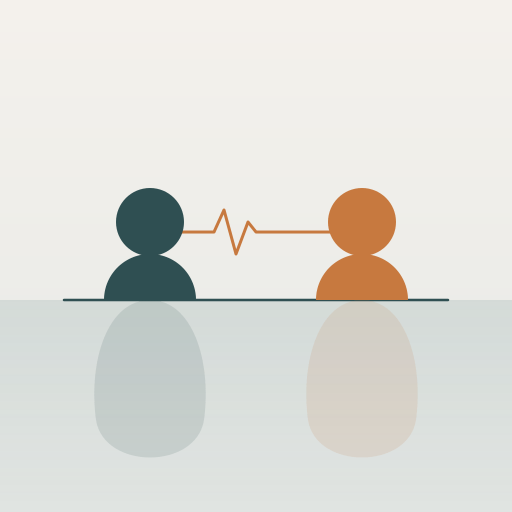
Two people sit across a table. They lived through the same argument, in the same room, with the same words hanging in the air. Yet when they tell you what happened, you would swear they were describing two different events. One heard a raised voice threatening to walk out the door. The other heard ordinary friction, the kind any relationship survives. Same sound, two different meanings.
If you mediate, you have watched this happen more times than you can count, and you have probably chalked it up to personality, or stubbornness, or one party being “difficult.” I want to offer a different explanation, one that has become my central thesis after years in that third chair.
Conflict is not only a disagreement over substance. It is an attachment event.
The moment two people feel threatened in a relationship, the brain’s oldest relational machinery comes online and begins governing what they perceive, feel, and do, almost always below conscious awareness. The fight on the table is the visible ten percent. The other ninety percent is happening inside each person’s nervous system, in a drama that started long before they walked into your office. The mediator who manages only the words is managing only the tip of the iceberg and wonders why the thing refuses to melt.
Let me make the case for putting attachment at the center, the way I would over coffee, because the idea is too useful to bury in jargon.
The template everyone brings to the table
John Bowlby noticed something that now seems obvious but was radical at the time. A baby’s bond with its caregiver is not a by-product of feeding. It is a survival system, as basic as breathing. From thousands of small moments (reaching out, being soothed or not, being met or being left), a child builds what Bowlby called an internal working model. It is a pre-rational set of expectations about a few enormous questions. Are other people reliable when I need them? Am I worth caring for? What must I do to stay safe when a relationship gets shaky?
Nobody walks around reciting these beliefs. They run underneath everything, like the operating system you never see. And conflict is exactly the situation that boots them up. It acts directly on the bond, drains each person’s ability to regulate, and raises the stakes of being honest and exposed. Translated: conflict is rarely processed as a neutral problem to be solved. It is processed as a question about whether the bond is safe.
That is why your two parties remember different fights. Their working models filtered the same event into different meanings before either of them said a word.
Mary Ainsworth gave us the categories most of us still use, and Mary Main later added a fourth. The shorthand is familiar, but it is worth pinning down what each does under pressure.
The secure party treats conflict as a solvable problem within a bond that will hold. They can disagree, hear something hard, and still keep a dual awareness running in the background: “This is difficult, and the relationship is not ending.” They compromise, self-disclose, and tolerate the other person’s distress without retaliating or fleeing. They are the easiest people to mediate, and when just one party in a pair is secure, the whole interaction tends to improve, almost regardless of the other person’s style.
The anxious party arrives already braced for abandonment. When the bond feels threatened, their system engages in what Mikulincer and Shaver call hyperactivation. It turns the alarm up. They pursue, protest, press for reassurance, and cannot let the dispute rest. Their distress is loud and visible. Here is the part most people miss: the escalation is not aggression for its own sake. It is a desperate bid for responsiveness wearing the costume of an argument.
The avoidant party does the opposite, a move called deactivation. They turn the alarm down. They minimize, change the subject, go flat, and resist any compromise that would require them to lean on someone. Their apparent calm gets read as reasonableness, or sometimes as contempt. Both readings are usually wrong. Decades ago, researchers asked avoidant people to recall attachment threats they had just verbally shrugged off, and their skin-conductance readings lit up. The calm is a surface. Underneath, they are often as aroused as the loudest person in the room, and they have simply gotten good at hiding it, including from themselves.
And then there is the disorganized, or fearful-avoidant, party, who wants closeness and fears it at once. They approach, then attack. They open up, then bolt. They are the hardest to mediate, because the move that calms them in one moment can frighten them in the next, and because their history often includes trauma, the conflict reactivates without warning.
Once you can see these four patterns, something shifts. A conflict style is no longer a fixed personality trait you have to correct with better technique. It becomes the visible surface of an attachment strategy doing its protective job. Anxious escalation is a bid for connection. Avoidant withdrawal is a bid for safety. Read a conflict style backward, and it becomes a map to the unmet need driving it. The escalating party is not simply impossible, and the silent one is not simply checked out. Each behavior names a need, and needs can be met.
The table becomes its own creature
Here is a layer that changed how I work. Murray Bowen argued that a family’s emotional life is not the sum of its individuals. It is a system with its own automatic processes, and the fuel that runs it is anxiety. When anxiety rises, the system reaches for old reflexes (taking sides, picking fights, distancing) to restore equilibrium.
Now think about what happens when your parties sit down. For the length of that session, a brand-new emotional system forms, with its own climate and its own anxiety level. The table acquires an identity. It is not a neutral container where two pre-made conflicts get aired. It is a living thing whose collective anxiety rises and falls, and that level quietly decides what kind of thinking is even possible. When it spikes, both parties lose access to the problem-solving part of their brains and snap back to reflex. When it settles, the same two people become capable of perspective-taking and compromise that they could not manage ten minutes earlier.
Which means the mediator is not standing outside the system, refereeing. The mediator is the most influential member. Bowen’s word for the goal is differentiation, the capacity to stay thoughtful and self-defined while staying emotionally connected to people who are losing it. Your job is to be the most differentiated presence in the room, the one who refuses to get absorbed into the rising panic or pulled onto either side. Because emotional systems are regulated by contagion, a mediator who stays steady lowers the anxiety of the whole room. This is the machinery underneath a piece of craft every experienced mediator already knows in their bones: the calmer you are, the more reasonable everyone else becomes. You are running the thermostat.
The body keeps the score, right there at the table
We like to think conflict happens in the mind. It does not. It happens in the body first.
Bessel van der Kolk made the point that threat registers in the body and the survival brain before anything verbal. The body keeps the score. Under threat, the nervous system mobilizes, the rational prefrontal cortex gets downshifted, and in intense states, the brain’s speech centers can go offline, which is why a flooded person cannot find words. When a party floods or freezes, its physiology has shifted into a defensive state that the words on the table cannot reach.
Bruce Perry explains why this governs what you can do. The brain processes from the bottom up, brainstem first and cortex last, so a dysregulated lower brain blocks access to the thinking brain above it. You cannot reason with someone whose survival state is running, because the reasoning equipment is, in that moment, physiologically unavailable. Perry’s clinical sequence is three words long, and I would put it on the wall of every mediation room if I could: regulate, then relate, then reason. Regulation is not a warm-up before the real work. It is the precondition that makes the real work possible.
The familiar “fight or flight” is also too short a list. The nervous system offers at least four survival moves, and attachment history shapes which one a person defaults to. Fight is the body surging toward aggression, the voice rising, the person attacking or defending, and it tends to show up in anxious parties. Flight is the body trying to escape: agitation, pressured speech, leaving the room, changing the subject. Freeze is the shutdown, going blank or numb or silent. The stonewalling that looks like contempt is very often a freeze state, a physiological collapse rather than a strategic snub, which is exactly why the “calm” avoidant party can be quietly off the charts inside.
Fawn deserves its own warning. It is appeasement: placating, over-accommodating, abandoning your own needs to defuse the threat and rescue the bond. Fawn is the most dangerous response at a mediation table precisely because it appears to be cooperation. It is not. An agreement reached from a fawn state is appeasement, not consent, and those agreements tend to fall apart later, because they were never really the person’s own. When someone agrees too fast and too completely, do not celebrate. Get curious.
The operational lesson is to stop reading the body as a verdict on good faith. Freeze is not contempt, fawn is not consent, fight is not necessarily bad faith. Each is a nervous-system state, not a negotiating choice. And because these are bodily states, they respond to bodily interventions: a break, a breath, grounding, and slowing the pace. You fix the problem where it actually lives.
The skill nobody was born with
If regulation is the whole game, the practical question is how you build it in the room. The most useful framework I have found comes from Dialectical Behavior Therapy, which Marsha Linehan developed for chronically dysregulated clients. DBT has four skill modules, but the one that matters most at a mediation table is distress tolerance: the ability to survive an emotional crisis without making it worse, without escalating, fleeing, or caving.
That is the entire job description of a person at a mediation table, and it is exactly what insecure attachment undermines. Anxious parties try to discharge their distress through the other person. Avoidant parties try to escape it by leaving the field. One finding from this research I think about constantly is that decreasing maladaptive coping tends to help more reliably than adding adaptive coping. So often your highest-value move is not a brilliant reframe. It is interrupting the bad cycle long enough for the system to settle.
There is one more correction the attachment lens forces. We usually teach emotion regulation as a solo skill, something you do inside your own head. At root, it is interpersonal. The infant borrows the caregiver’s already-steady nervous system, and we never fully outgrow the design. Even when under threat, adults still reach out to another regulated person to help them settle. Which means you are not coaching two people to self-soothe in parallel. You are the steady nervous system that both parties borrow until they can stabilize their own. Regulating the system is not a metaphor for managing the mood. It is the literal mechanism by which dysregulated people become capable of negotiating.
One room, two opposite prescriptions
This next part, once it clicked, changed my practice. Research on the therapy relationship shows that people form genuine attachment bonds with helping professionals, treating them as a safe haven under stress. The mediator occupies a similar seat for the life of a session: a temporarily idealized, neutral figure whose steadiness the parties borrow. And that reframes neutrality itself. Neutrality is not emotional absence. It is the reliable, non-anxious availability that lets frightened people do frightening work.
But here is the catch. You cannot deliver that security to everyone the same way, because the anxious and the avoidant parties need opposite things.
The anxious party needs containment and reliable responsiveness. Their escalation is a question: “Have I been abandoned at this table?” Meet it with coldness or impatience, and you confirm the fear, which cranks the protest higher. You settle them with structure, explicit acknowledgment (“I heard that, and we will come back to it”), and steady contact, while gently keeping the flooding from drowning the room. What does not work is matching their intensity or leaving their bids hanging.
The avoidant party needs the reverse: space, autonomy, and low-pressure ways in. Push them to emote or demand immediate disclosure, and they withdraw further, because dependence is the exact thing their strategy exists to avoid. You reach them by respecting their autonomy (“you decide how much to say”), working through facts and interests before feelings, and refusing to chase. Do not mistake flat affect for low stakes. The rule of thumb: increase the distance for the one reaching, decrease it for the one withdrawing, until each can tolerate a more balanced spot in the middle.
When a pursuer and a withdrawer end up in the same room, you get one of the most corrosive patterns in human conflict, the demand-withdraw cycle. Understand it not as two people who each happen to be a mess, but as a failed mutual-regulation loop. The pursuer escalates to extract reassurance, triggering the withdrawer to shut down and remove the very reassurance the pursuer was hunting for, thereby intensifying the pursuit. Each person’s attempt to feel safe is the other’s trigger. Your job is to interrupt the cycle and name it without blame: “When one of you presses and the other steps back, you each get more of what you fear.”
Why “positions to interests” is so hard, and what actually unlocks it
Every interest-based mediator has tried to move parties from positions (the concrete demands they show up with) to interests (the underlying needs beneath them). And every one of us has watched a party clamp down on a position like a dog on a bone, no matter how cleverly we ask the question.
Attachment explains why. A position is a defensible, external demand. An interest is a vulnerable, often unspoken need. To move from one to the other is to expose yourself, the very act that insecure attachment is built to prevent.
For the anxious party, the position (“I want the house,” “I want an apology”) is fused with a deeper need to feel valued and not discarded, so conceding it does not feel like a compromise. It feels like an erasure of the self. For the avoidant party, the position defends autonomy. A fixed, self-sufficient stance keeps the exposed, dependent conversation out of reach, and deactivation keeps the real interest hidden, often even from themselves.
So the move from positions to interests is not primarily a cognitive task to be solved with sharper questions. It is a regulatory one. A party cannot safely name an interest while their attachment system is still firing, because naming it requires the very vulnerability the threat response is busy suppressing. The sequence does not bend: regulation first, then interests become reachable, then durable agreement becomes possible. Push for interests before the parties are regulated, and you will watch their positions harden, because the request to be vulnerable has itself become a threat.
A starter kit you can use on Monday
None of this requires you to diagnose anyone, slap on a label, or turn your session into therapy. It requires structured noticing and disciplined responding. Five moves carry most of the weight.
First, regulate before you reason. Before you touch substance, read the room’s arousal. If someone is flooded or shut down, lower the temperature first. Perry’s three words say it all.
Second, be the thermostat, not the thermometer. Your own steady nervous system is the most powerful intervention you have. Unhurried voice, even breathing. Do not match anyone’s intensity.
Third, match the distance to the style. Space to the one withdrawing, contact to the one reaching.
Fourth, name the pattern, not the person. Describe what the system is doing rather than what either party is. It externalizes the cycle and takes the blame out of the room.
Fifth, validate first, solve second. A brief, genuine “that mattered to you, and I understand why” answers the attachment bid and frees up bandwidth for problem-solving. Validation is not agreement. It is the precondition for agreement.
A little psychoeducation helps too. When you explain that a racing heart or a blank mind is a physiological reaction, not a character flaw, you convert a terrifying story (“I am being attacked”) into a workable one (“our alarm systems are firing”). Understanding is itself regulating.
What I want you to carry out the door
The research settled the basic question long ago. What our field has been slow to ask is: what should the mediator do about it? When researchers listened to real mediations, the speech of secure parties was audibly more useful toward resolution, and they asked, plainly, for mediators to start paying attention.
So here is the shift I am asking for. The next time two people sit across from you, remembering two different fights, resist the urge to decide which one is unreasonable. Neither of them is, really. Each is running an ancient program designed to keep them safe, and it is louder than they are. The escalating question is whether they still matter. The silent one is asking whether it is safe to need anything at all. Your first job is not to solve their problem. It is to become, for one hour, the steady presence that lets their nervous systems borrow enough calm to do the hard, exposed work resolution requires.
Regulate, then relate, then reason. Substance always rides on regulation, never the other way around. Get the order right, and the same two people who could not speak civilly will surprise you. That is not a trick. That is what a secure base has always done, all the way back to the crib.
The full working paper, with the complete research and citations behind these ideas, is available at the end of this post.


Leave a Reply