
What attachment science reveals about why conflict goes sideways, and how to bring it back
I once sat with a couple who spent forty minutes locked in combat over a dishwasher. Not the marriage, not the years of feeling unseen. Just the dishwasher. He loaded it “wrong.” She “had to redo it every night.” Their voices climbed; his went flat and clipped while hers got faster and louder, until she finally said, almost to herself, “I just want to know you’d notice if I disappeared.”
The room went quiet. Because that was the real conversation. It had been the whole time. The dishwasher was just the thing they could say out loud.
I’ve watched some version of this happen at countless tables, and it taught me something I now build my whole practice around: people are almost never fighting about the thing they’re fighting about.
The question underneath the argument
Underneath most heated conflict is an older, faster question that the nervous system asks before the conscious mind catches up: Am I safe here? Can I count on you? Am I about to be left or dismissed? Psychologists call the machinery that asks it the attachment system, and conflict is exactly what switches it on.
When a relationship feels strained, that system takes the wheel, and it doesn’t treat the disagreement as a neutral problem to solve. It treats it as a referendum on whether the bond is safe. That’s why two people can sit through the identical conversation and leave with two completely different stories about what happened. One hears a raised voice as friction to work through. The other hears the same raised voice as proof that abandonment is coming. Same words; different internal software; different reality.
Two engines: up or down
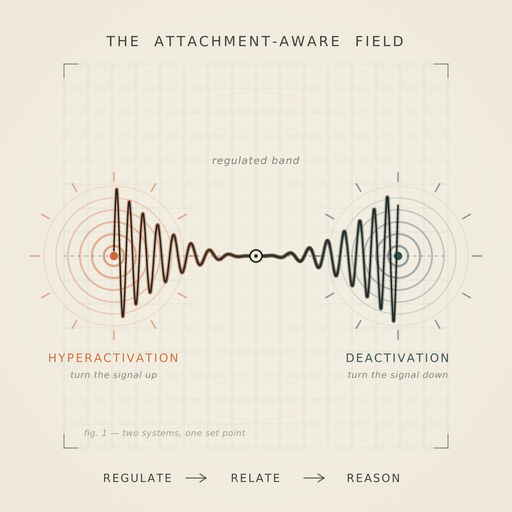
When the alarm fires and we don’t feel reassured, we don’t all do the same thing. We split into two strategies, and learning to spot them changes everything.
Some people turn the alarm up. More pursuit, more protest, more pressing for reassurance. The unspoken logic: if I protest loudly enough, you’ll respond to me. From the outside, it looks like an escalation. From inside, it’s a desperate knock on a closing door.
Others turn the alarm down. They go quiet, get very “reasonable,” change the subject, withdraw. The logic: I can’t count on anyone, so I’ll need no one. It looks calm or cold, but researchers who’ve measured these “calm” withdrawers find their bodies are often as aroused as anyone else’s. The stillness is a lid on a boiling pot, not an empty one.
Here’s the reframe worth keeping:
Escalation is a bid for connection wearing the costume of an argument. Withdrawal is a bid for safety, wearing the costume of indifference.
The loud person isn’t simply difficult. The silent one isn’t simply reasonable. Each behavior names a need.
The four people who show up to every conflict
Those two engines sort most people into four recognizable patterns, and you’ll probably spot yourself in one of them.
The secure one treats conflict as a solvable problem inside a relationship that isn’t going anywhere. They can disagree without it becoming an emergency and hold two things at once: this is hard, and we’re going to be okay. Even one steady, secure person tends to lift the whole room.
The anxious one shows up already braced to be left. They pursue, protest, circle back, and can’t let anything rest. Their distress is loud and visible, but it’s really a frantic are you still there?
The avoidant one shows up by minimizing and exiting, going abstract, sticking to facts, checking the time, and keeping their face flat. The calm gets misread as reasonableness or contempt, but the arousal underneath is real, just hidden.
The fearful one wants closeness and fears it at the same time, often because of real hurt. They approach, then attack; open up, then slam shut. With them, safety and predictability matter more than progress, and sometimes the honest move is to slow way down.
None of these are boxes that fix a person. They’re patterns, held lightly, that help you respond to what’s actually in front of you instead of the costume it’s wearing.
Why can’t you reason your way out
This is the part most conflict advice skips: conflict isn’t experienced first as a thought. It’s a bodily event. When your system reads threat, the thinking brain, the part responsible for perspective-taking, impulse control, and problem-solving, gets downshifted. You literally can’t access it. That’s why the perfect comeback arrives in the shower three hours later.
So there’s a sequence worth tattooing somewhere visible: regulate, then relate, then reason. You cannot reason with a person whose survival state is active, because in that moment, the reasoning machinery is physically offline. Calming things down isn’t the soft preliminary before the real work. Calming down is the real work, the precondition that makes everything else possible.
What to actually do
Five moves, usable by anyone:
- Regulate before you reason. Check the temperature before you touch the substance. If someone’s flooded or shut down, lower the heat first: slow your voice, name the feeling, offer a breath or a break.
- Be the thermostat, not the thermometer. A thermometer rises with the room; a thermostat sets the temperature. Your steady nervous system is your most powerful tool. Calm is as contagious as panic. Whatever you do, don’t match their intensity.
- Match the distance to the style. The anxious and the avoidant need opposite things. Give the one reaching contact and acknowledgment. Give the one withdrawing space and a low-pressure way back in.
- Name the pattern, not the person. “When one of us pushes and the other steps back, we each get more of what we fear.” Make the cycle the enemy, not each other.
- Validate first, solve second. “That mattered to you, and I get why,” answers the real question. Do I matter? That frees up the bandwidth that was busy defending. Validation isn’t agreement; it’s what makes agreement possible.
Once people feel safe enough, the same two humans who couldn’t speak civilly five minutes ago can solve the problem they came to solve.


Leave a comment