
Posted on June 16 | Bryan Stafford
A better way to read intense faith, and a working hypothesis on telling devotion, coping, compulsion, and conscience apart. This is the first edition of this essay and is in draft form.
By Bryan Stafford
A fictitious story, but the concept holds: A person sits across from me and describes a faith of unusual intensity. Hours in prayer. A recurring fear that he has sinned in some way he cannot quite name. A restless need to be certain, really certain, that God is pleased with him. Or perhaps there is a focus on religion to the point of asking whether this is beyond devotion. What is devotion as I consider the tradition, culture, and lifestage. The intensity is not in question. The question is what “intensity” means.
That single question has been turning over in my mind for a while, and this post is my attempt to think out loud about it. I want to say at the outset that this is a working hypothesis. I have been reading across three fields that rarely speak to one another, trying to synthesize what each of them sees, and what follows is an evolving piece of work rather than a finished verdict. I am sharing the messy middle on purpose.
Intensity Is the Wrong Question
Our first instinct is almost always to reach for a dial. We assume devotion shades into something unhealthy somewhere along a single line marked “more religious,” and that our job is to find where on that line a person sits. Too little, and they are lukewarm; too much, and they are in danger.
The research keeps warning us off exactly that move. When studies separate plain religiosity from scrupulosity, the religious-obsession form of OCD, it turns out that scrupulosity, not religiousness itself, carries the link to distress. More striking still, scrupulosity tends to be inversely related to religious commitment and spiritual well-being. The tormenting kind of religiosity, in other words, is not mature faith turned up to eleven. If anything, it is faith’s counterfeit, pulling in the opposite direction.
This lines up with something the confessional tradition has always insisted on: we have never measured faith by how it feels. Faith is reception, a heart clinging to a promise that comes from outside itself, rather than the magnitude of religious emotion. Intensity, for the clinician and the theologian alike, is simply the wrong place to look.
Four States That Wear the Same Face
If intensity cannot sort them, what are we even sorting? It helps me to name four states that can all show up looking like fervor:
Devotion. Mature faith, lived for God’s own sake.
Coping. Religion was pressed into service to manage unbearable feelings. From the outside, it can look identical to devotion.
Compulsion. Scrupulosity, the religious subtype of OCD, where intrusive guilt drives endless ritual and reassurance.
Conscience. What Luther called Anfechtung, the genuine terror of a soul that has heard the Law and not yet heard the Gospel.
Here is the hard part. The same observable behavior (long prayer, fear of sin, hunger for assurance) can belong to any of the four. And each one calls for a completely different response. A response fitted to the wrong state can deepen the very suffering it means to relieve.
Three Maps We Already Have
We are not starting from scratch. Three bodies of work each light up part of the field, and I want to be clear that I am building on them, not replacing them.
The clinical literature on OCD gives us the sharpest markers for compulsion. A true obsession is experienced as unacceptable, alien, and abhorrent to the person having it. Clinicians call this ego-dystonic, which is very different from a sin a believer recognizes as his own. Underneath sit two engines: an intolerance of uncertainty (the inability to bear not-knowing) and thought-action fusion (the sense that thinking something is as bad as doing it). The telling feature is that reassurance and rituals never resolve the doubt. Relief is brief, and the doubt comes back stronger.
The psychology of religious coping offers the best lens on function, namely, what religiosity is doing for a person. It distinguishes positive coping from negative coping (reading hardship as God’s punishment or as spiritual discontent) and names spiritual bypass: the use of belief to avoid the hard emotional work underneath. The discriminating question here is teleological: is the practice aimed at God, or at managing one’s own feelings? The Reformers would have recognized this as the old question of whether the heart seeks God for God’s sake or uses God as an instrument, a subtle idolatry in which one’s own peace becomes the thing actually worshiped.
The pastoral-theological tradition gives us the fourth state, the one that the clinical databases barely cover. Anfechtung is not a disorder. It is the proper terror of the sinner who has heard the Law, the Law of which Scripture says “through the law we become conscious of our sin” (Romans 3:20), and the tradition treats it as a station on the way to faith, answered not by self-examination but by absolution.
Each map is right about its own territory. What none of them does, on its own, is tell you how to tell all four apart, in the room, while the person is still speaking.
A Different Way In (Two Small Additions)
This is where I think a confessional standpoint has something modest but real to add. Two things.
The first is a move I borrow from mediation: naming. At the table, a good mediator surfaces what everyone is feeling but hasn’t said, and then watches how the room receives it. In counseling, naming does double duty: it is both a gentle intervention and a diagnostic probe. There is solid science under it: putting feelings into words (“affect labeling”) reliably lowers emotional reactivity, even when people do not believe it will. But the real information is in the reception. When you name the pattern, what does the person do with it?
Mature devotion and faithful struggle tend to recognize the naming, hold it, and feel relieved at being understood.
The person with OCD who still has insight can come to see the loop as a loop, the hopeful case.
Religion-as-avoidance tends to spiritualize the naming right back at you.
The person with little insight cannot step back at all. The naming gets argued with, or, most tellingly, converted on the spot into a fresh demand for reassurance (“but are you sure it’s just a loop? so I’m okay, right?”).
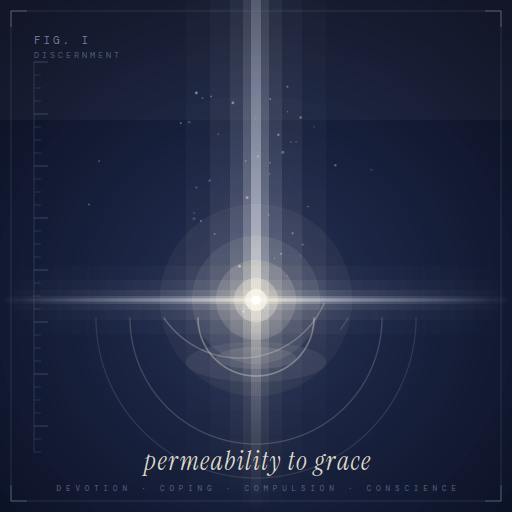
The second addition is the one I keep coming back to, and it is the heart of this working hypothesis. I would propose that the sharpest single criterion separating these states is what I have been calling permeability to grace, the capacity to receive and retain an assurance that comes from outside yourself.
True faith and genuine Anfechtung are permeable. The word of forgiveness, once heard, can land and hold. The terror is answered, and the person rests, even if the assault returns later.
Scrupulous OCD is impermeable. The same word goes in and immediately leaks out, because the disorder cannot tolerate the uncertainty the promise asks the person to live with.
Religion-as-coping shows a third profile: the word is received, but valued for the comfort it produces rather than for the One it announces, kept only as long as it is doing emotional work.
I want to emphasize that I have not yet measured any of this. There is no validated instrument for permeability to grace; building one would be genuinely useful. There is no dedicated measure for Anfechtung either. This is a lens, offered as a hypothesis, not a test score.
Why Absolution Is Not Just More Reassurance
This is the distinction that does the real work, and it is one that the clinical literature cannot supply on its own. Reassurance-seeking is an internal loop: it grounds your standing in your own verification, so it has to be repeated, because the verification never quite holds. Absolution is structurally the opposite. It is extra nos, a word spoken from outside you, grounding assurance not in your certainty but in Christ’s promise: “the Spirit himself testifies with our spirit that we are God’s children” (Romans 8:16).
So in principle, the Gospel is not simply one more dose of reassurance. The subtlety, and the reason discernment matters so much, is that the disorder can consume even that external Word as if it were information, just one more datum to check. The very same sentence, “there is now no condemnation for those who are in Christ Jesus” (Romans 8:1), can heal a conscience genuinely terrified by the Law and feed a scrupulous compulsion. That is why a pastor’s absolution, offered again and again on demand, can quietly entrench OCD even as those identical words set a terrified conscience free.
A Simple Way to Walk Through It
If I had to compress all of this into something you could actually hold in your head during a conversation, it would be three questions and two probes, used gently, in order, and never mechanically.
Start with three questions (not “how much?” but):
Direction. Is this religiosity oriented toward God, or toward relief? Where is it actually pointed?
Cognition. What thoughts are driving it? Are they recognized as the person’s own, or experienced as alien, intrusive, abhorrent? Is there inflated responsibility, or an inability to tolerate uncertainty?
Function. What is the religiosity for? Is it an end in itself, or a tool for managing feeling, or for avoiding it?
Then try the first probe: name it once. Surface the pattern plainly and kindly (“each time you reach for certainty, the relief is brief and the doubt comes back stronger”), then watch the reception, which often tells you more than the content did. And here is the discipline: name it once, and hold the line. Do not re-litigate it on demand. Re-explaining “it is only the OCD” forty times is just reassurance wearing a clinical costume, and reassurance is one of the best-documented ways to make OCD worse.
Then watch for the second probe: permeability. When a word of grace is spoken, does it land and stay, or is it spent the instant it arrives and immediately demanded again? Permeable points toward faith or Anfechtung, both of which the Gospel answers directly. If impermeable points toward the disorder, and toward structured, exposure-based care and coordinated work with the person’s pastor, rather than more words of comfort, the disorder will only persist.
One honest limit. All of this assumes the person has enough insight and enough distance from their own experience to consider the account you are offering. Where insight is poor, naming will not land on the first try. That failure is not a dead end; it is itself diagnostic, pointing away from talk and toward more structured treatment.
A Working Hypothesis, Held Loosely
I will end where I started. This is me synthesizing scattered literature, and the framework here is a proposal, not a settled result. The treatment evidence specific to scrupulosity remains thin, the confessional Lutheran population is nearly absent from research, and the two moves I am most attached to, naming as a probe and permeability to grace, still await real testing. I expect to revise this.
 Life Vocations
Leave a comment