
Posted June 2026, copyright 2026
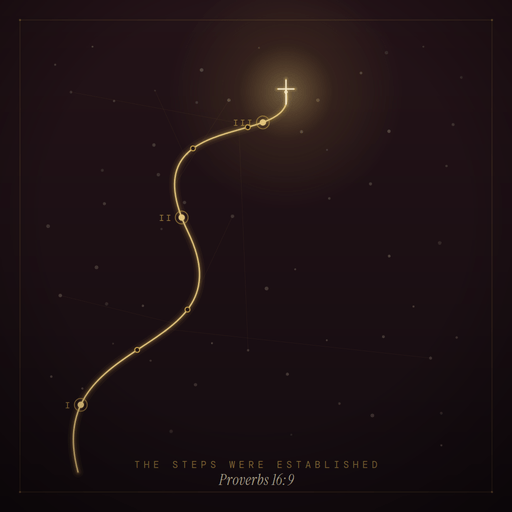
“In their hearts humans plan their course, but the LORD establishes their steps.” — Proverbs 16:9 (NIV)
The Question I Didn’t See Coming
I am usually pretty quick on the uptake. Here is the picture.
It is a cold Wisconsin March afternoon, the kind where the sky never quite commits to anything and the light outside the window stays the color of dishwater all day. I am teaching Introduction to Management. We are working through Lead Like Jesus, and I have wandered, the way I do, into the harder territory underneath the textbook. I had begun asking what it actually means to be a Christian in a postmodern, secular business world, where the language of calling and service has mostly been replaced by the language of optimization and personal brand. I am in the zone.
And then a hand goes up.
This is startling, because in a room of business undergraduates on a gray afternoon, hands do not typically go up unprompted. He asks, more or less, the question I had stepped right past: “You say that God has played a role in every step of your life. How do you actually know that?”
That question took me back. Not because I doubted the claim (I had just made it, after all), but because I had said it the way you say things you have stopped examining, the way you describe the weather. He was asking me to show my work.
Here is what I said in the moment, and I have not improved on it since:
“I believe God has walked my path with me, because I can see the patterns in my past, and how all of it led to this very moment, to us having this conversation. It’s too perfect. It’s too patterned to be random.”
This essay is the longer answer. It is the work shown, and to show it honestly, I have to start before I have any memory at all.
What I Actually Believe
Let me say plainly what I am and am not claiming, because the difference matters and a lot of bad theology lives in the gap.
I am a firm believer that God directs our steps for a reason. I do not mean this as a slogan stitched on a pillow. I mean it the way the Proverb means it: I plan my course in my heart (I genuinely plan, I genuinely choose, the choosing is real and mine), and the Lord establishes the steps. Both halves are true at once. This is the simul I keep returning to in my writing: I am fully an agent and fully held, at the same time, with no contradiction. My practice, when I am living it well, is to pursue opportunities wholeheartedly and then surrender the outcome to the Lord.
That surrender is the hard part. If I am being honest, the planning has never been my problem. I am good at planning. The hard part, the part I am still bad at, is the listening. I tend to be a bit stubborn that way. I will pursue a door so hard and so long that I miss the one God left standing open behind me, and only later, looking back, do I see that the door I was pounding on was always going to stay shut, and the open one was the whole point.
So, I want to be careful here about what I do not believe. I do not believe God authors every harm and then hands it to me as a gift to be unwrapped with gratitude. The theology of the cross, the lens I read my whole life through, forbids that. A theologian of glory calls the bad thing good and the hard thing easy. A theologian of the cross calls the thing exactly what it is and then trusts that God is present in it anyway, working sub contrario, under the appearance of its opposite, found not above suffering but inside it. That distinction is the difference between faith and a pious lie. I will need it almost immediately and more than once.
Three Flash Points
I have come to understand my life as a series of flashpoints, specific moments when an event occurs and changes the course of everything so deeply that it changes who you are. I have had three.
The most recent was September 2006, when I looked into my son’s screaming eyes and finally knew what love is. Before that came October 1997, when I took Mellisa’s hand at St. Peter’s and understood at last what it means for two to become one. And the first, though I was only three months old, was March 1975, when my father took his life.
Hold those three together for a moment, because the shape of them is the whole argument. Two of them are pure gifts: a wife, a son, joy I did nothing to deserve. One of them is pure wound, a thing I would undo in a heartbeat if undoing it were mine to do. And the line of God’s providence does not run around the wound to get to the gifts. It runs straight through it. The worst thing in my life is upstream of the best things in my life, and I cannot cut the cord between them, no matter how I try. That is not a tidy thought. It is a cross-shaped one.
Here is how I have seen it play out.
Born in Death: Rhinelander, and My Father
I was born in death. I was born to care for my mother.
That is not a dramatic way to open, and it is not a cry for help. It is just a fact, the way the date on a birth certificate is. Death came into my life before I had words for it, before I had memory, before I could do anything but lie in a crib and be cared for. Three months after I entered the world, my father left it. He ended his own life in the basement of our family home in Rhinelander. It is Hodag country, whispering pines and quiet lakes, the kind of place tourists call God’s country and put on postcards. There was no slow unraveling. It was instant: a before and an after, with a wall between them that was absolute, and I arrived just in time to be carried across it without ever seeing the other side.
I have to be honest about a strange thing that sits at the center of everything. I do not grieve my father the way you might expect a son to. I can’t. To grieve someone, you have to have known them, and I never did. When I say the word father, it comes out of my mouth like a word in a language I don’t speak correctly, but empty. No voice I can recall, no scent, no smile, no embrace. He worked at the lumber mill, taught Sunday school, played hockey, and loved to sing. I write those down the way you’d copy them off a form. They are true, and they are nothing to me, because the man they describe was never mine to lose. What I had instead was an absence with my last name on it.
This is exactly the place where cheap theology rushes in, and I have to refuse it. I will not say God authored that death, so good could come of it. The God revealed in Christ is not the author of that basement. What I will say (what the theology of the cross actually licenses me to say) is that God was not absent from it. He was hidden in it, working under its opposite, present in the very place a grieving family would have sworn He was nowhere to be found.
And I have grieved it every day since, in ways the standard grief literature was never built to hold. I have written elsewhere about what I call stacking grief, the way a single visible loss quietly activates a whole stack of other griefs that never get a funeral. My family grieved the man. I grieve something stranger: not having a father, not knowing from the inside how to be one, mourning a family unit I could never picture because it never existed for me to remember, living from the start in a world quietly fractured by violence and shame.
But here is what that fracture made. My brothers and sisters were nearly grown; they did the only sane thing and walked out into their own lives, and I have never blamed them for it. That left me, the baby, the last one, the one whose whole life would be lived in the shadow of that spring. And in the wordless logic of a child I understood my role before I could have told you I understood anything: everyone else will move on, but this one won’t. I would be the constant. The anchor. I would not leave. I took that yoke onto my own small shoulders and, God help me, I was proud to carry it. I carried it for nearly fifty years.
The only Rhinelander that is actually mine is a handful of bright fragments floating on top of that dark thing: a tire swing turning slow, a hot metal playground, a freight train I wandered toward down the backyard tracks while my mother ran for me in a terror I can only now imagine, and the afternoon I hid behind the good living-room curtains and ate an entire stick of butter like a banana. To this day that memory gives me the willies. I keep it anyway, because a boy who hides behind the curtains eating butter is a boy who is, in that moment, getting away with something delicious and entirely his own, and there was not a lot in those years that was entirely mine. The pattern of my whole life is already in those fragments: the boy who wanders off alone toward the edge of something, and the mother forever running after him, terrified of what the world will take from her next. Neither of us would ever fully outgrow our part.
The House That Beer Built: Spencer
My earliest real memories don’t have pictures. They have a smell. Stale cigarettes, and underneath it the sour malt of beer dried tacky on the linoleum overnight. That is the smell of the house my mother’s second marriage built, in Spencer, Wisconsin, home of the Rockets, out in the flat middle of the state among the cornfields. We rode the rocket down there when I was four, and for years I thought of it as a little place of hell on earth.
I want to be fair to my own childhood, because it was not all darkness and a story that pretends otherwise is just another kind of lie. There was an ordinary ’70s and ’80s boyhood threaded right through the bad: cops and robbers until I was filthy, the woods at the edge of town, my BMX bike in long loops through the neighborhood until the streetlights buzzed orange and meant home, supper, time’s up. Those evenings are mine. I get to keep them.
But around the good there was always the other thing, and it had three faces: isolation, fear, and drink. The isolation cut deepest and was the quietest: no real friends, no sleepovers, no one who came looking. Just the blue light of the television on weekend nights and a boy filling the hole where another life should have been with snack cakes and ice cream, because food was company and food didn’t leave. The hardest day of the year, of all things, was Valentine’s Day, when the cardboard box went around the classroom and somehow never reached my desk. And every single year my mother would come home from work with a small heart-shaped box of chocolates and a kiss on the top of my head, just for me. I can still feel the lift in my chest: the pure, uncomplicated certainty that I was loved, that I belonged to someone, that I had been remembered. The chocolates never survived to morning. They were never meant to. They were a once-a-year proof, devoured on the spot, that somewhere in the world there was a person whose job it was to make sure I got a valentine.
The fear had a face too, and I will name it honestly and then lay it down, because I do not believe a child’s suffering becomes more true by being piled higher. My stepfather was a violent, vengeful man, and he was unpredictable, which was the worst of it. The weather could change from a clear sky. I learned to read a room the way other kids learned to read books, scanning for the early signs, calculating the odds. The best outcome available to me on a given day was to be left alone, invisible. There was a cigarette put out on the back of my hand for handing over the wrong tool. There was a sound through a wall I have never forgotten and never will. And in that house I made a vow, over and over, a private liturgy in the dark: my children will never live in fear like this. They will never flinch at a footstep. Whatever else I become, I will not become this. I didn’t know yet how I would keep that promise. I only knew, with the whole force of my small furious heart, that I would.
And there was the night on the back of the snowmobile. I was five years old, tearing through the dark woods from one tavern to the next, so numb I had gone somewhere far away from my own body. I knew I was supposed to hold on. I knew that if I let go, I’d come off at the next turn. And some small voice beneath the numbness said, “let go,” so I did. I opened my arms, the turn took him, and I landed in the soft, deep snow at the edge of the trail and watched his one red taillight swing around the bend and wink out, and the engine fade to a whisper to nothing. I was not hurt. I was not even afraid. I made a snow angel and looked straight up at an enormous, cold sky full of stars, and for once I felt that nothing in the world could reach me. And then, in the very next breath, the only thing I was actually afraid of came back: my mother. Where was she? Was she all right? It is the first time in my life I remember truly worrying about her, lying in a snowbank a drunk man had left me in. It would be far from the last.
Now, what does a theologian of the cross do with a chapter like that? Don’t call it good. It was not good. God did not arrange a man’s cruelty for my benefit, and I will not insult the boy I was by pretending He did. But I can tell you what was forged in that house, under the opposite, in a place I would have sworn God had abandoned. The watchfulness I learned reading that man’s moods became, decades later, the thing that lets me sit in a room with two people in conflict and feel the temperature change before either of them says a word. It is the spine of everything I now do as a mediator and a counselor. The vow I made in the dark became, by grace, a chain I would one day break instead of pass down. And the numb little boy in the snowbank, worrying about his mother under the stars, grew into a man who has built a whole vocation out of being the steady presence for people in their worst moments. None of that redeems the cruelty. The cruelty stays exactly what it was. But God was in that snow. I am as sure of it now as I was unsure of it then.
By the Big Lake: Sheboygan
We did not leave Spencer cleanly. My mother ran once, to Sheboygan, and then (this is the part nobody warns you about) she went back. The pull of the familiar is strong even when the familiar is harmful, and watching her get drawn back taught me more about the gravity of co-dependence than any textbook ever has. It took a second divorce, the one that finally held, to get us back to Sheboygan for good, a city on the edge of a lake so big it has its own horizon.
So I came up by the big lake as the perennial new kid, and I learned that wounds move when you move; they don’t stay behind in the old house. But Sheboygan is also where the weather of my life finally started to break. My mother fell in with a man named Rodger, and for the first time I got to watch her begin, tentatively, to be happy: the Bricco gatherings, the dog, the decorating she loved. After everything, she had a steadier season, and I needed to see it almost as much as she needed to live it.
And it was in Sheboygan, in my senior year of high school, that I came to the fork I now believe everything turned on. I could become the men who had raised me (that road was wide open, well-traveled, and would have surprised no one), or I could become something else. I had been fed a steady diet of you will never amount to anything, you are a waste, fed it so often it had stopped sounding like an insult and started sounding like a weather report. The decision to disbelieve the weather report was the most genuinely mine decision I have ever made. I think of George Bernard Shaw’s line, that the people who get on in this world are the ones who go looking for the circumstances they want and, not finding them, make them. I went looking. I would be the first in my family to leave for college, and leaving carried its own guilt, because leaving meant loosening, just slightly, the tether I had carried since infancy.
But notice the shape of it, because this is the heart of what I actually believe. That decision was wholly, freely mine. I planned my course in my heart, exactly as the Proverb says. And it was also, just as wholly, the step God was establishing the whole time. The fork in the road in Sheboygan is the cleanest illustration I have of the simul I keep preaching: a free man choosing, and a faithful God establishing, in one and the same act, with no seam between them. I chose. He led. Both are true.
The Lego Set: My Business Life
My professional life is where the pattern becomes almost comic in its precision, though it certainly did not feel funny while I was living it.
My career started at VPI Commercial Floor Products (yes, doesn’t that sound exciting), as a marketing intern. This is more significant than it sounds. It was the mid-90s. Jobs were not plentiful, and a marketing internship that converted into a full-time role where I could explore every facet of the discipline was not a small mercy. It was a foundation.
And then the path got rough. The skills I built at VPI carried me to another company, and another, and another. It was not a clean climb. There was real instability. One company ended in a downsizing that was done to me, not by me. I lasted only a few months before I quit. One paid a genuinely high wage, and passed the cost on to my family, which is a bargain I now know better than to make.
From inside it, this looked like a man who could not get his footing. What I could not see, what you can almost never see in the middle, was that each company was teaching me something I would need and could not have learned anywhere else. One taught me how to run a company. One taught me, just as valuably, how not to. I was a Lego set being assembled one brick at a time by hands I couldn’t see, and the thing about a Lego set is that no single brick tells you what you are building. You only know when it is finished. Only on the far side of all that instability could I look back and realize I had been made ready, piece by piece, to start a business of my own.
And even that did not arrive in the shape we first reached for. Mellisa and I started by trying to launch a dog daycare. We spent nearly six months chasing locations, and everyone fell through, false start after false start, door after closed door. It was demoralizing. It was also, I now understand, providence saying not that, not there, keep going in the only language I seem reliably able to hear, which is the language of a door that will not open no matter how hard I push. The business that never happened is the reason the business that did could exist.
The Classroom I Never Applied For: Teaching
Teaching is the vocation I backed into entirely.
It started with guest speaking, just showing up to talk to a class for an afternoon. That turned into substituting in business courses. The substituting turned into an adjunct position at the very college where I had earned my MBA. The adjunct work turned into a part-time professorship. At no point did I draft a plan to become a professor. I simply kept saying yes to the next small thing, pursuing each opportunity wholeheartedly with no idea where the staircase led, and surrendering the rest.
This is what the Lutheran tradition means by vocation (Beruf), and it is bigger than most people realize. A calling is not reserved for the pulpit. God works through ordinary people in their ordinary stations (as workers, as teachers, as spouses, as parents) to care for the world and serve the neighbor. And it is no small irony that the question that prompted this entire essay (how do you know God has played a role?) was asked of me in a classroom I never set out to stand in.
The Cafeteria: Mellisa, Grace, and the Family We Were Given
And then there is the flash point I would defend as evidence in any court.
I met Mellisa in college. We were both commuters, driving in from separate communities, two people whose paths had no structural reason to cross. We met on a whim, in the cafeteria. That is it: a chance encounter over a meal between two people who lived in different towns and would have had no other occasion to meet. We discovered we shared a remarkable amount, the kind of overlap that makes two strangers realize very quickly they are not strangers. The whim led to dating. The dating led, in October 1997, to St. Peter’s, where I took her hand and finally understood what it means for two to become one.
But I have to tell you the deepest thing that meeting did, because it is the most direct answer this whole essay can give to that student’s question. Through Mellisa, and through the years that followed, I came home to Christ. I had been a roaming Catholic, religious in the loose, drifting way a man can be when faith is an inheritance he has never personally unwrapped. Walking toward her, I walked into a confessional Lutheran understanding of the Gospel, and for the first time I knew Jesus not as a figure in other people’s stories (the way my father had always been a figure in other people’s stories), but as my Savior. The cafeteria did not just give me a wife. It was the door through which Christ came to get me. When the student asked how I know Jesus has played a role in my life, the truest answer is that He arranged a chance lunch to do it.
It has not been a frictionless path, and I will not pretend otherwise. That would be the theology of glory again, calling the hard thing easy. We walked through infertility, a grief with its own quiet stack of losses beneath the visible one. And then, through it and after it, came Nathan, our son, becoming a family in September 2006, whose screaming newborn eyes taught me what love is on a crowded street in Seoul. Now, he will be graduating with a marketing degree, the same field where his father’s whole improbable Lego set began. And in the raising of him, I finally kept the vow I had made in the dark in that house in Spencer: he never flinched at a footstep, never learned to read a room before he could read a sentence. The chain that ran down to me stopped at me. By grace, I did not pass it on. I broke it. Trace the line back. A loss in infancy took us from Rhinelander. The fractures moved us to Spencer and then, finally, to Sheboygan. Sheboygan put me at the fork where I chose another life, and on the road to the college where, in a cafeteria, on a whim, I met Mellisa, who led me to Christ, to marriage, and, after a grief, to Nathan. Pull any single brick out of that and the whole structure changes. I cannot make myself believe that is an accident. It is too perfect. It is too patterned to be random.
The Curvy Plan, and Finally at Rest
Here is the thing I most want to say, the thing the student’s question finally pulled out of me.
Each of these threads developed in near-total isolation. The grief did not know about the business. The business did not know about the teaching. The fatherless boy in the snowbank had no idea he was being made into a man who could sit with other people’s worst nights. Each thread unspooled on its own timeline, in its own town, answering its own immediate question, with no visible coordination between them. If you had shown me any one of them mid-stream, I could not have told you what it was for.
And yet they braid. They run toward each other. The watchfulness forged in fear becomes the gift that steadies a mediation. The unstable career becomes the toolkit for a stable business. The vow made in the dark becomes a chain broken in the light. The roaming, fatherless son becomes a confessional Lutheran who knows whose he is. None of these lines is straight. God does not seem to work in straight lines, or, if He does, the lines are simply longer and curvier than I can see from where I stand. It is a curvy plan, and the curves are precisely the parts I would have edited out if anyone had handed me the pen.
This is why I cannot reduce my faith to either of the two answers the secular world keeps offering. One says I am a self-made man who overcame a rough start by force of will. The other says it was all random, coincidences my pattern-hungry brain dressed up as meaning. I do not believe either. I believe a third thing: a God who directs the steps of a man who is genuinely walking, genuinely free, who genuinely plans and chooses and fails, and who is, the whole time, being established.
My mother is at rest now. The bond that was struck in a basement in Rhinelander and set like concrete in a beer-soaked house in Spencer (the one that made me, before I could speak, the constant who would never leave), I carried it faithfully all the way to the end, which was the one thing I had promised the world I would do. I do not grieve her as those who have no hope. I trust the promise that those who fall asleep in Christ are not lost but kept, and that she woke in the warm embrace of the Jesus I met, improbably, in a college cafeteria. A story that begins in death does not have to end there. Mine began in death and is being rewritten, line by curving line, by grace.
So how do I know Jesus has played a role in my life?
I know it the way I told that student on the gray afternoon. I know it because when I stop pounding on the closed doors long enough to actually listen (the hard part, the part I am still bad at), I can hear the pattern. And the pattern is too perfect, too patterned, too curvy-on-purpose to be anything other than a path that was walked beside me the whole way. Walked beside me from a basement I cannot remember to a classroom I never planned to stand in, where a young man raised his hand and, without knowing it, asked me to count the steps.
I planned my course. The Lord established my steps. He still is.


Leave a Reply