
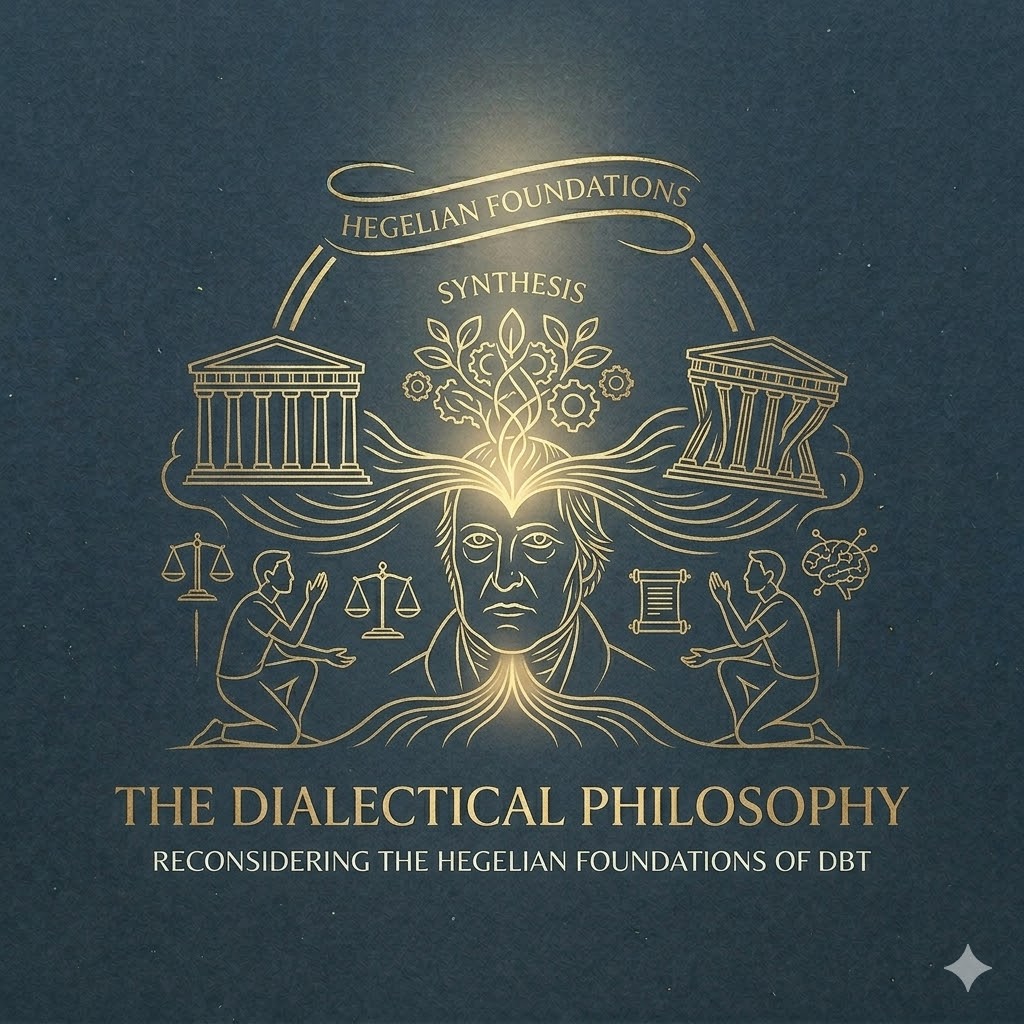
The Therapy That Borrowed the Wrong Last Name
There is a quiet moment in good therapy that I have come to think of as the whole game. A person sits across from you in real pain. Maybe they have spent the week saying cruel things to themselves, or burning a relationship to the ground, or simply white-knuckling their way from morning to night. And the helper has two instincts at once. One instinct says, “This makes sense. Of course, you feel this way. You are doing the best you can.” The other instinct says, “And this cannot continue. You deserve a different life, and we are going to go get it.”
Most of us assume those two instincts are at war. We think we have to pick a side. Either we accept the person as they are, which feels kind but a little hopeless, or we push them to change, which feels hopeful but a little brutal. We have all been on the receiving end of both mistakes. The friend who only nods and validates until you start to wonder if anyone believes you can do better. The friend who only fixes and corrects until you start to wonder if anyone sees you at all.
The remarkable claim at the center of dialectical behavior therapy is that you do not have to choose. You can fully accept a person and relentlessly press for change in the same breath, and not as a compromise. Not as one eye on each. As a single, unified stance where both are completely true. A client can be doing the very best they can and can do better. Hold those together, and something loosens. The false choice dissolves.
I came to this idea the way most clinicians do, through the work rather than through a seminar. It struck me first as a clinical instinct that simply works. Only later, when I went looking for where the idea came from, did I trip over something strange. The philosophy that DBT credits as its foundation, I think, is the wrong one. The therapy has been walking around for thirty years, wearing a name tag that belongs to someone else.
That is what I want to talk through here. It sounds like an argument for specialists, and at one level it is. But stay with me, because beneath the philosophy lies a very human question about how change actually happens in a person, and getting the answer right changes how we treat each other and ourselves.
A word with a complicated family
The word at the heart of all this is “dialectical.” It shows up right in the therapy’s name, and it is doing a lot of work.
Strip it down, and a dialectic is just a way of thinking about opposites. Two things that seem to contradict each other turn out to need each other, and the truth lives in how they move together rather than in either one alone. Acceptance and change. Stability and growth. Holding on and letting go.
Marsha Linehan, the psychologist who built DBT, was explicit that this dialectical worldview sits underneath everything the therapy does (Linehan, 1993). And when she traced the intellectual lineage of that worldview, the trail she pointed to ran through dialectical materialism. Which is to say, through Karl Marx.
Now, that is a respectable pedigree. The trouble is that the more closely I read the actual logic of what DBT does in the room, the less it looked like Marx and the more it looked like someone else entirely. Someone, Marx, spent his whole career trying to flip upside down. I mean Georg Wilhelm Friedrich Hegel.
So here is my thesis, and I will put it plainly so you can hold me to it. To the extent that DBT’s dialectic has any real philosophical shape, that shape is Hegelian, not Marxian. The therapy gestures toward Marx. The working logic is Hegel’s. It borrowed the wrong last name.
Let me show you why that is not just academic hair-splitting.
Marx’s version: opposites at war
Start with the dialectic that actually carries Marx’s name, because it is worth being fair to it.
Here is a small irony to keep in your back pocket. Marx never used the phrase “dialectical materialism.” The systematic doctrine was largely assembled by his collaborator Friedrich Engels and then hardened, sometimes into something close to dogma, by the later Marxist tradition (Engels, 1878/1947). What Marx himself gave us was a method and a famous reversal. In the afterword to the second edition of Capital, he described his relationship to Hegel as an inversion. The dialectic, he said, had been standing on its head, and he meant to set it on its feet (Marx, 1867/1976). For Hegel, the engine of all development was the movement of thought, of ideas. For Marx, the engine was material life, the gritty business of who owns what and who works for whom, and ideas were just the shadow that material conditions cast on the wall.
Engels boiled this down into a few laws, the most famous being that development is driven by internal contradiction (Maybee, 2020). But notice what kind of contradiction Marx cared about. It was antagonistic and social. The clash of classes whose interests simply cannot both be satisfied. The factory owner and the worker are not having a misunderstanding that a good conversation could fix. Their interests genuinely collide.
And so, resolution, in the Marxian picture, does not look like balance. It looks like victory. One side overthrows the other. The old order is swept away, and a new one takes its place, and history grinds forward toward a final destination. Three things define this dialectic, and I want you to hold onto them. It is materialist, meaning the physical conditions explain everything else. It is antagonistic, meaning contradiction is a fight one side has to win. And it is historical and collective, meaning it describes whole societies moving through epochs toward an endpoint.
Now, picture a therapy room. A single suffering person. None of those three features is to be found anywhere. And that, right there, is the problem with crediting DBT to Marx. You cannot run a healing relationship on a philosophy of class war. So where does the actual logic come from?
Hegel’s version: opposites reconciled
This is where the philosopher Charles Taylor becomes my favorite guide, because Taylor spent his career making Hegel readable for the rest of us, and his reconstruction of Hegel maps onto therapy with an almost eerie precision (Taylor, 1975, 1979).
Hegel did not begin with matter. He began with a problem that anyone alive today will recognize. Division. He looked at modern life and saw a person split against themselves and against the world. Reason set against feeling. Freedom set against nature. The individual is cut off from the community. He had a wonderful German word for that condition of being torn in two. Entzweiung. A splitting apart.
And here is the move that makes Hegel Hegel. He did not want to resolve these divisions by declaring a winner. He wanted to overcome the opposition without erasing either side. The German word for that achievement is Versöhnung, reconciliation (Taylor, 1979). Not a truce. Not one pole stamping out the other. A genuine healing of the split, in which both parties survive and are made whole.
How does that happen? Through a process Hegel named with a word he clearly loved, because it does three jobs at once. Aufhebung, usually translated as sublation. The word means, all at the same time, to cancel, to preserve, and to lift up (Hegel, 1830/1991). When a contradiction is sublated, the two opposing sides are not destroyed, nor are they blended into some gray, lukewarm average. They get taken up and carried to a higher level that keeps what was true in each.
If you learned in school that Hegel was about “thesis, antithesis, synthesis,” I have slightly bad news. He almost never put it that way. That tidy formula was bolted on later (Taylor, 1975; Maybee, 2020). What Hegel actually described was this richer motion, this preserving and transcending, where difference is held inside a larger whole instead of being abolished.
Two things in Taylor’s reading land directly on the therapy couch. The first is that Hegelian reconciliation is non-eliminative. Unity does not flatten differences. It sustains them. The whole, Hegel insists, is the living movement of difference being reconciled, not some static sameness. The second is that Hegel was emphatic about the body. The self is not a floating intellect. It is a living, situated, embodied being, and its freedom gets realized in and through its finite, physical life, not by escaping it (Taylor, 1975).
Sit with that for a second. A philosophy where your suffering and your limits are not obstacles to be conquered on the way to some abstract goal. They are the raw materials that any real integration must include.
You can probably already feel where this is going.
Watch the two pictures meet the therapy
Set both models down next to DBT’s defining move.
The whole therapy turns on the synthesis of acceptance and change. Radical acceptance of the client and of present reality, held together with steady, unembarrassed pressure toward a life worth living (Linehan, 1993). The job is not to make acceptance defeat change, or change defeat acceptance. The job is to hold both as fully true and to find, moment by moment, a stance that honors what is right in each.
Read that again and then read the definition of sublation. Cancel the one-sidedness. Preserve the truth of both poles. Lift the person to an integration that neither pole could reach alone. It is almost a word-for-word match. DBT’s central technique is Aufhebung in business casual.
Now run the Marxian test, feature by feature, and watch it fail.
Are DBT’s contradictions antagonistic, like warring classes? No. Acceptance and change are not enemies with incompatible interests. They are partners. The synthesis is reconciliatory, not revolutionary. It preserves both sides instead of overthrowing one.
Is DBT materialist in Marx’s strict sense? No. It does not claim your consciousness is just a reflex of economic production. Its actual theory of how people develop is biosocial, an ongoing dance between your biology and your environment, which is a far cry from a thesis about who owns the factories.
Is DBT’s goal a collective historical endpoint, a classless society at the end of time? No again. The goal is intimate and personal. The integration of a divided self into a life that the person experiences as worth living. That shape, the healing of an inner Entzweiung through reconciliation, is Hegel’s signature, not Marx’s.
And then Taylor’s two emphases close the case. Hegelian reconciliation refuses to eliminate either pole, and so does DBT, which never asks the client to delete their emotional reality even while it works hard to change their behavior. Hegel insists that the self must inhabit its embodied life rather than flee it, and DBT’s bread-and-butter skills, mindfulness and distress tolerance, are essentially disciplines of inhabiting your own present, physical experience rather than negating it. The therapy treats a person’s pain not as an enemy to be overthrown but as a moment to be acknowledged and folded into a larger, more livable whole. That is reconciliation in Taylor’s exact sense.
I should be honest: I am not the first to notice this, which actually strengthens the point rather than weakens it. Linehan’s own reading list leans toward the developmental tradition more than the materialist one. She drew, for instance, on Michael Basseches, whose research on adult thinking describes the mind maturing precisely by integrating opposing perspectives into bigger, more comprehensive wholes (Basseches, 1984). That is sublation in a lab coat, not class struggle. And clinicians who have looked at the question head-on in the same place. The psychiatrist Steven Reidbord, writing about dialectics in psychotherapy, points out that although the word “dialectical” took on its materialist coloring with Marx, DBT actually runs on the Hegelian meaning, where a thesis meets its own contradiction and the two resolve into a greater truth, which then keeps unfolding (Reidbord, 2019).
What I am not saying
Intellectual honesty means marking the edges of an argument, so let me be careful here.
I am not claiming that Linehan built DBT by sitting down with Hegel’s Science of Logic and applying it line by line. She did not, and she has always been candid that the dialectical worldview came into the therapy as a sensibility, a way of seeing, rather than as a finished metaphysical system. Some critics push even harder and say DBT is not rigorously dialectical in either the Hegelian or the Marxian technical sense, that it just borrowed the word to name its both/and posture. That criticism has real force against any grand reading, and I do not need the grand version.
My claim is narrower and, I think, harder to dodge. It is comparative. To whatever degree DBT’s dialectic has a genuine philosophical shape, that shape is Hegelian, reconciliation and sublation of preserved opposites, rather than Marxian, materialist and antagonistic, and marching toward a collective historical end. I am not crowning a winner in a philosophy contest. I am pointing out that the therapy filed its paperwork under the wrong name.
Why this should matter to you, even if you never set foot in therapy
Here is where I think this stops being a debate for footnote enthusiasts and starts being useful.
The name you give a process quietly shapes how you run it. If you carry a Marxian picture of change in your head, even without knowing it, you will treat the parts of yourself you want to fix as adversaries. The lazy part. The anxious part. The part that keeps reaching for the thing you swore off. On that model, growth means war. You pick the side you approve of, and you crush the rest. And almost everyone has tried to change this way, through self-contempt, through declaring war on a piece of themselves. It is exhausting, and it mostly does not work, because the part you are trying to destroy is still you, and you cannot win a war in which you are both armies.
The Hegelian picture asks something harder and, in the end, kinder. It says the goal is not to defeat the unwanted part but to understand what it was protecting, what truth it was holding on to, and to carry that truth into a wider way of living where you no longer need the old strategy. You stop trying to amputate the anxious part and start asking what it was so afraid of, and then you build a life roomy enough to hold both the fear and the courage. Nothing true gets thrown away. Everything gets lifted up.
You can use this tomorrow, and you do not need a therapist to do it. The next time you catch yourself in that familiar internal standoff, the part that wants to rest against the part that wants to push, the part that wants comfort against the part that wants growth, try resisting the urge to make one of them the villain. Assume, for a moment, that both are telling you something true. The tiredness is real, and so is the longing to do more. Then ask the genuinely interesting question, which is not “which one wins” but “what would a life look like that honors both of these at once.” That question is the whole Hegelian engine, running in your kitchen.
It is also, I think, the quiet reason people in DBT actually get better. The therapy works without ever asking anyone to win a war against part of themselves. It holds the contradiction open, patiently, long enough for something larger to take shape. Not a compromise. Not a truce where each side gives up half. An integration where the divided self becomes, at last, one person who can both accept where they are and move toward where they want to be.
The right ancestor
So that is my small correction to the family tree. My attraction to the dialectic in DBT turned out to be an attraction to something genuinely Hegelian wearing a Marxian name tag.
Marx gave us a dialectic of struggle, in which contradiction is a fight that one pole has to lose, and history drags us toward a far-off collective end. Hegel, as Taylor recovered him for us, gave us a dialectic of reconciliation, where contradiction drives a one-sided position up into a higher unity that cancels what was narrow in it while preserving and lifting what was true. DBT’s synthesis of acceptance and change, non-eliminative, embodied, aimed at gathering a divided self into a life worth living, answers to the second description and not the first.
Naming the ancestor correctly takes nothing away from what Linehan accomplished. If anything, it clarifies the achievement, and it brings me back to the quiet thing that drew me in to begin with. The dialectic refuses to make a person choose between being accepted and being changed. It turns out that the deepest kind of change was never a war we had to win. It was a reconciliation we had been waiting to be offered.
And maybe that is worth carrying past the therapy room. Most of us are walking around a little split in two, accepting ourselves on the good days and trying to fix ourselves on the bad ones, never quite letting both be true at the same time. Hegel’s old, difficult insight, smuggled into a modern therapy under the wrong name, is that you do not have to keep choosing. You can be fully met where you are and still be on your way somewhere better. Those were never opposites. They were always waiting to become a whole.
The full academic paper this article is based on, “The Dialectical Philosophy: Reconsidering the Hegelian Foundations of Dialectical Behavior Therapy,” including complete citations and references, appears at the end of this post.


Leave a Reply