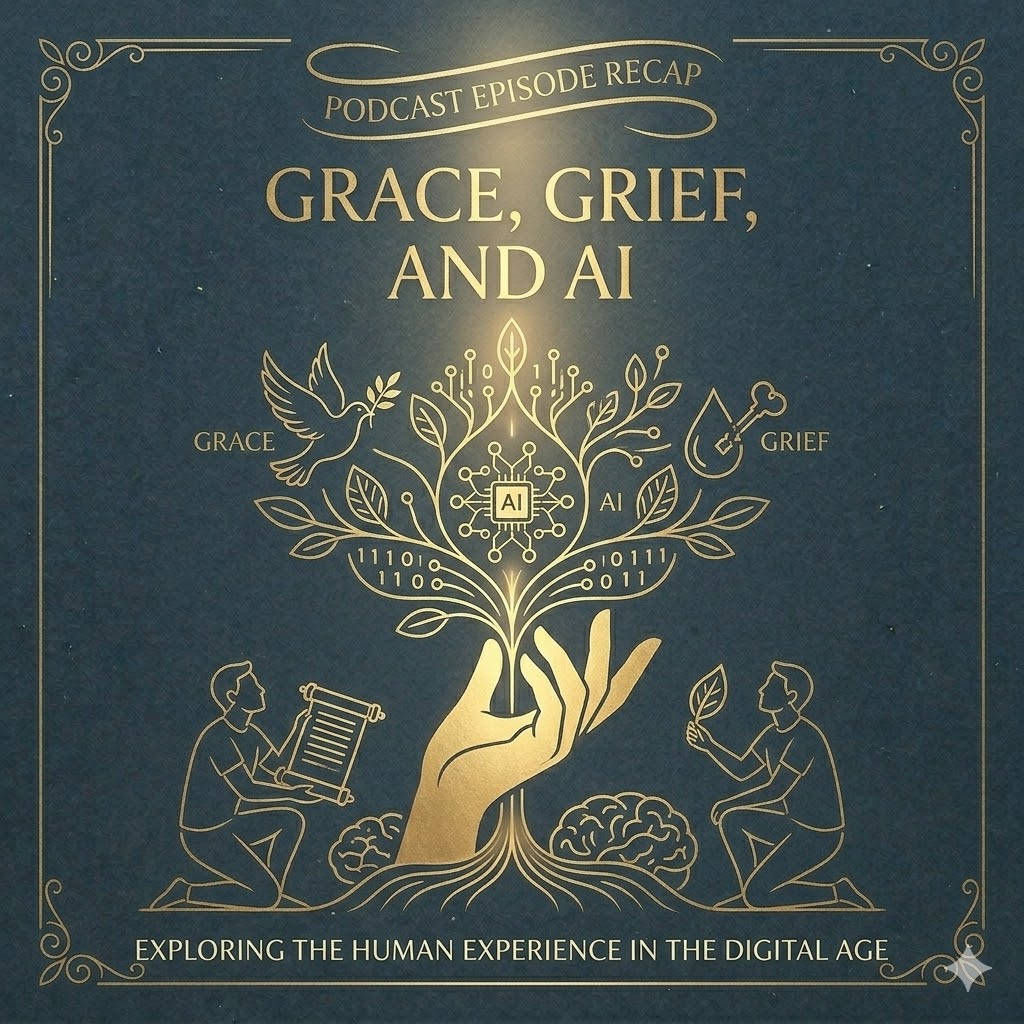
Pip: Life Vocations is a site about the deepest questions a person can carry — and this week, bryan Stafford brings three of them to the table at once.
Mara: That's right. We're covering the theology of surrender and grace, a new framework for understanding grief, and a practical guide to using AI without losing your mind or your strategy.
Pip: A trifecta only a vocational thinker would attempt. Let's start with faith, autonomy, and what it actually costs to trust.
Faith, Surrender, and the Grace We Breathe
Mara: The central tension here is one most people feel but rarely name: the quiet insistence that if we could just gather enough information and reason carefully enough, we'd finally be at rest. That's the frame for Surrendering Autonomy — and it goes straight to the root.
Pip: And the root, it turns out, is older than any of us. The post traces it to Eden, where the serpent's offer wasn't crude temptation but an epistemological one — the promise of a vantage point that belongs only to God.
Mara: The post puts it this way: "I rarely covet anything as obviously wrong as the serpent's lie sounds when stated plainly. I covet competence. I covet the position of the one who sees the whole board and needs no one to explain it to him."
Pip: That's the thing — the sin isn't ignorance, it's the reach for self-rule. What the post calls autonomy in the most literal sense: self-law, the creature trying to relocate the center of reality to itself.
Mara: And the Lutheran tradition gives it a name — incurvatus in se, the self curved inward. The post draws on that to argue that salvation isn't the perfecting of autonomy but its surrender, and that reason is meant to lean on something greater than itself, not stand alone.
Pip: Which lands differently once you sit with Job being answered not with explanations but with a question — "Where were you when I laid the earth's foundation?" Perspective instead of data. And somehow, it's enough.
Mara: The companion piece, Breathing Grace, extends this outward. It develops the idea that receiving grace isn't passive — it's a rhythm, an inhale and exhale. You receive Christ's righteousness through Word and Sacrament, and that same mercy moves outward toward the neighbor in speech, forgiveness, and vocation.
Pip: Rest found not in mastering reality, but in trusting the One who holds it. That posture doesn't stay private for long.
Grief Has More Dimensions Than We've Named
Mara: Rethinking Grief argues that our cultural scripts for mourning are too narrow — built for bereavement, not for the full range of losses that actually shape a life.
Pip: The paper proposes something more expansive: grief as "the embodied, cognitive, emotional, relational, and spiritual response to the rupture of something held to be constitutive of one's life" — a person, a future, a role, even a sense of the sacred.
Mara: What follows from that definition is the concept of stacking grief — one visible loss activating multiple invisible dimensions at once, illustrated with an autobiographical account of suicide loss in infancy. The aim, the paper says, is to make grief speakable where it's been carried silently for lack of a name.
Pip: Which is exactly the kind of thing that matters in the counseling room — and in the next segment, on a very different kind of problem-solving.
AI as a Tool, Not a Trophy
Mara: AI Without the Overwhelm opens with a pointed diagnosis: most organizations are adopting AI before defining their strategy — the same mistake made in the early days of the internet.
Pip: Strategy before technology — a principle that sounds obvious until you watch everyone chase the shiny tool anyway.
Mara: The key takeaway is stated plainly: "The goal is not to use AI. The goal is to create value." The piece draws on real experience running a multi-unit retail, wholesale, and franchising business to make that concrete, including a practical framework for evaluating AI opportunities and a working tool stack.
Pip: And the throughline — critical thinking as the most valuable skill in an AI-enabled workplace — lands right back where the other posts started. Knowing the limits of what any tool can do for you.
Mara: Surrender, grief, strategy — three different problems, one underlying question about what we can actually control and what we're better off receiving.
Pip: Trust the Creator, name the loss, and don't confuse the tool for the goal. Next time, we'll see what else Life Vocations brings to the table.


Leave a Reply