
The Grief You Were Never Allowed to Name
May 2026
By Bryan D. Stafford
When most people hear the word grief, they picture one thing: a funeral. A casket, a black dress, casseroles on the counter, a stack of cards in the mail. That picture is not wrong. The death of someone we love is the oldest and heaviest grief there is, and almost everything we know about mourning was built on top of it.
But that picture is not the whole of grief. And treating it as the whole has a cost.
Plenty of people carry losses that look nothing like a funeral. The future that was supposed to arrive and never did. The version of themselves they will never get to become now. The relationship that ended without ending, the door that closed before anyone said goodbye. These people feel something that walks like grief, talks like grief, and reorganizes their inner life like grief. And then they look around, see no casket, and conclude that whatever they are feeling cannot really be grief.
So they swallow it. They call it disappointment, or failure, or “just being dramatic.” They tell themselves to get over a thing they were never allowed to name in the first place.
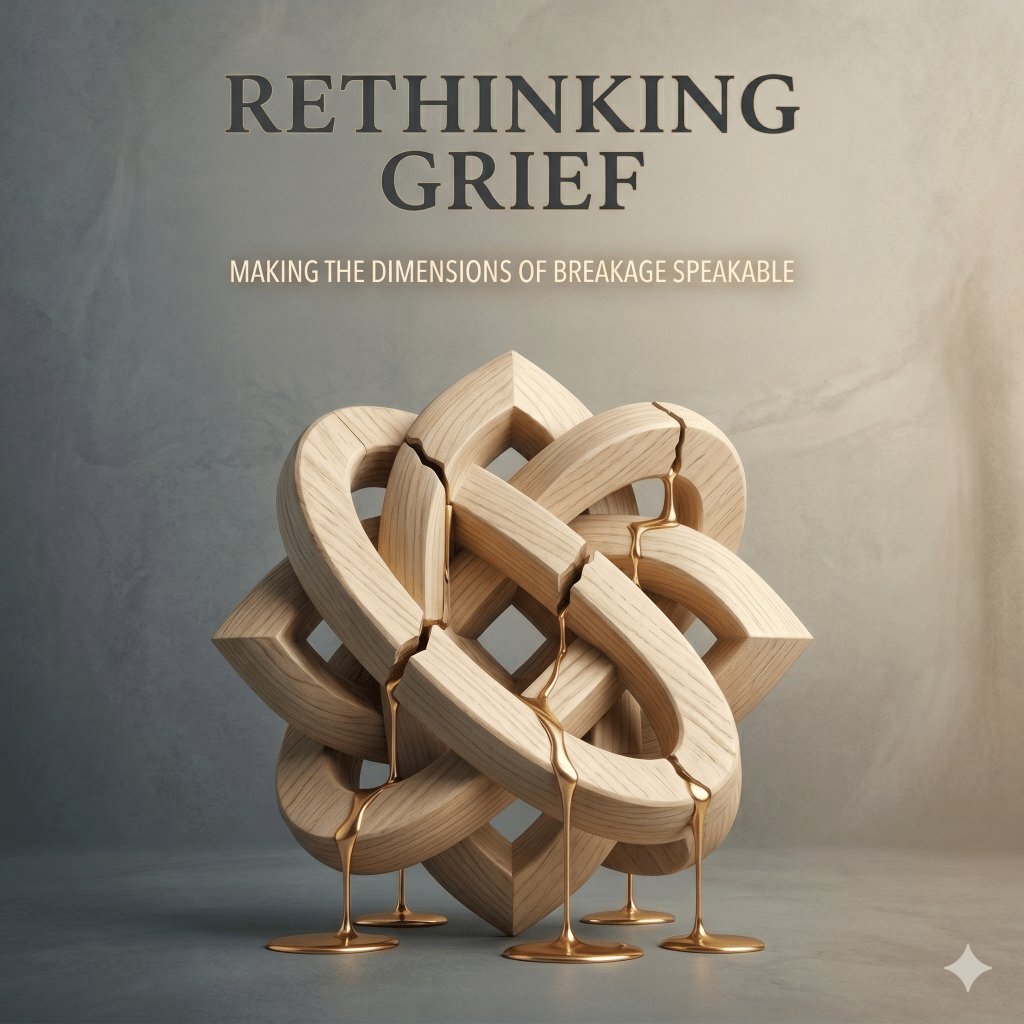
Here is the idea I want to put on the table, the one I have spent years working out and have finally written down. Grief is not a single event with a single shape. Grief is what happens when something that was holding your life together is torn apart. Sometimes that something is a person. Sometimes it is a future, a self, a community, or a sense that the universe makes sense. And because the thing that ruptures can take so many forms, grief shows up in far more places than our funeral-shaped vocabulary can account for.
Naming matters. That is the whole argument in one line. Unnamed grief does not stop working. It only stops being recognized.
Why the old maps fall short
We did not arrive at the funeral-only view of grief by accident. We inherited it.
Freud, back in 1917, framed mourning as the slow work of letting go, of withdrawing your attachment from the person you lost so you could move on. The goal was detachment. Half a century later, Kübler-Ross gave us the famous five stages, denial through acceptance, which she developed by sitting with dying patients and never intended as a rigid checklist for the bereaved. It became one anyway. To this day people apologize for grieving “out of order,” as if there were an order.
Both maps were useful. Both were also too small.
Later researchers spent decades correcting them. The bereaved, it turns out, usually do not sever the bond with the person they lost; they carry a changed version of it forward, and that continuing connection tends to be healthy, not pathological. George Bonanno’s long-term studies found that the most common response to loss is not collapse but resilience, a fact that surprises people who assume prolonged suffering is the standard by which everyone should be measured. And Robert Neimeyer reframed the whole enterprise: grief, he argued, is at bottom a crisis of meaning. A loss blows a hole in the story you were telling about your life, and healing is the slow work of writing a story that can hold what happened.
I think all of that is right. I also think it stops short. Every one of those models still assumes the loss in question is a death. Everything else gets treated as a metaphor, a sort of grief-adjacent feeling we let in on a guest pass.
The losses I kept meeting, in my own family and in the people I worked with, were not on guest passes. They were the main event.
Ten doorways into the same house
So I started asking a different question. Not “how does grief feel,” which the roller coaster metaphors already answer well enough. The deeper question is: what, exactly, got ruptured?
When you ask it that way, grief stops looking like one thing and starts looking like a house with many rooms. I count ten, but you do not need the full inventory to get the point. They cluster into four simple relationships, four things every human life is built on.
There is your relationship to time. You can grieve a future that will now never arrive, like the grandchildren who will never be born or the conversation with an estranged sibling that death made permanent. You can grieve a hope that quietly failed to come to pass, the career or the marriage or the recovery that was supposed to take a certain shape and didn’t. You can grieve what once was and is no more, which is the familiar room, the one bereavement lives in. And you can grieve where you are right now, the chronic illness or the loneliness or the caregiving season that has no past tense because it is still happening.
There is your relationship to yourself. You can grieve the person you will never get to become, the parent or scholar or athlete that midlife quietly takes off the table. And you can grieve the person you were, the one who did harm, made the wrong call, lost years to something. That last one is its own kind of agony, because the person you are grieving is also the person doing the grieving. You cannot leave the room. You are the room.
There is your relationship to others. You can grieve a whole community rather than a single person, the congregation that scattered, the friend group that dissolved, the workplace that stopped feeling like a family. Chronic loneliness often turns out to be exactly this, a grief over connection itself.
And there is your relationship to the transcendent, to God or purpose or your sense of how the universe is supposed to hold together. This is the grief of the believer who suddenly feels abandoned, the grief of a faith coming apart, the grief of asking how a good world could contain this.
You do not move through these rooms one at a time. A single loss tends to throw open several doors at once. The death of an adult child opens the door to what was, and to the futures that won’t be, and to the parent that mother or father won’t get to keep being, and to the family table that will never look the same, and to the question of how any of it squares with God. One loss. Five or six rooms. All occupied at the same time.
The grief stacked under the grief
Here is where it gets quietly devastating, and where I think our culture fails people most.
When several rooms open at once, our public mourning customs can handle only one of them. We have scripts for the visible loss, the death itself. We have funerals and condolences and bereavement leave, usually about three days of it, calibrated to the assumption that the worst is over in a few weeks and basically finished within a year.
The other rooms get no script at all. No casserole arrives for the future that won’t happen. No card acknowledges the self you won’t become. So those griefs go underground. They keep generating loss on their own timeline, year after year, hidden behind the one death everybody already mourned and moved past. I call this stacking, and I call the thing that hides it the veil of death: the way a single, publicly mourned loss can cover a whole stack of private ones that nobody ever sees.
Suicide makes the stack heavier than almost any other loss. The research suggests that each suicide death directly exposes around 135 people to its shockwave. It leaves behind an unanswerable why, a layer of shame that other deaths don’t carry, and theological questions that families often cannot say out loud. The grief is not one grief. It is a stack, and most of it sits beneath the surface where no one thinks to look.
I know this one from the inside.
What I have watched my whole life
My father died by suicide when I was a little over three months old.
The family did everything the script asks. There was a funeral. People grieved. A new normal got built, and from the outside it looked like grief is supposed to look: a loss, a hard season, an adjustment, life going on. The death itself was mourned on schedule.
What I have watched, for as long as I have been old enough to watch, is everything the schedule missed.
My mother grieved the death, yes. But her grief never stayed in that one room. She has grieved what will never be at every single milestone my father did not attend: every graduation, every wedding, every grandchild he never met. She has grieved a marriage that never got the decades it was owed, and the wife she did not get to keep being. The cultural script accounted for her first year. It said nothing about the next fifty.
My own grief has been the strangest of all, because I have no memory of him. I cannot grieve what I had, since at the level of anything I can actually remember, I had nothing to lose. So I grieve the other rooms instead, and I grieve them densely.
I grieve the father I never got. I grieve the son I never got to be to a living dad. Most sharply, I grieve having had to build fatherhood from scratch, out of books and borrowed examples and prayer and a constant low ache of not knowing whether I was doing it right. A boy usually learns what a father is by watching one. I had to reverse-engineer it. And I grieve a world that was shaped, before I had any say in it, by an act of violence whose shadow has fallen across my faith, my sense of human fragility, and my idea of what it means to be a man in a world where that is even possible.
And then there is the strangest grief of all: grieving the grief itself. The years it took me to realize that what I was carrying was grief. The slow, disorienting recognition that the absence I had always treated as the plain background of my life was, in fact, the thing that had quietly organized all of it. To this day, when I open a book on bereavement, the categories almost never name what I have actually lived.
That gap is most of the reason I do this work at all.
How grief leaks
There is one more piece, because grief that has nowhere to go does not simply sit still. It moves.
Sometimes it moves between people. A grieving parent who never named their own stacked losses can pass the weight to a child, who grows up carrying a low hum of sorrow they cannot trace to any source, because the source was never theirs to begin with. A pastor’s unprocessed grief becomes the whole congregation’s mood. We catch grief from each other the way we catch a yawn, often without anyone noticing the transfer. Shared honestly, this is just community doing what community is for, bearing one another’s burdens. The trouble starts when no one knows the handoff happened.
Sometimes grief moves within a single person, sliding off the unbearable loss and onto a more manageable one. I call this cross-grief, and the cleanest analogy comes from addiction, where someone who quits drinking without dealing with the underlying ache simply migrates to overwork, or food, or a new relationship. The compulsion is real. It just found a new target.
Grief does the same thing. The person who cannot yet face a parent’s suicide may pour themselves into mourning a distant relative whose death they had already absorbed years ago. The grief is genuine. The loss is real and deserves to be mourned. But the intensity is the tell. When the size of the grief is wildly out of proportion to the loss in front of you, it is often carrying something heavier hidden underneath. The disproportion is the signal.
None of this is a character flaw. Early on, displacement is just how the mind protects you from what you cannot yet hold. It only becomes a problem when the protection hardens into a permanent detour and the real loss is never addressed at all.
So what do you actually do with this?
You might be waiting for the part where I hand you a technique. I am not going to, because the whole point is that there is no single technique. Different rooms need different help. Learning to tolerate a loss you can’t change is a different job from rebuilding a future, which is a different job from forgiving the person you used to be. The therapies that work, and there are several good ones, work because they meet a specific need, not because any of them fixes “grief” in general.
But there is one move you can make today, for yourself and for the people you love, and it costs nothing.
When someone seems stuck in grief longer than the visible loss seems to warrant, resist the urge to think they are doing it wrong. Ask a better question instead. Not “why aren’t you over this,” but “what else are you grieving?” Almost always, the reason a person can’t move forward is that one room was named and another wasn’t. The unnamed room keeps generating grief; the person feels the weight without understanding the source, and everyone around them mistakes a stack of real losses for an overreaction to one.
Turn that question on yourself, too. If something has been sitting heavy and you cannot quite explain why, you may be standing in a room nobody ever taught you to name. The disappointment that won’t lift. The anniversary that wrecks you for reasons you can’t articulate. The ordinary Tuesday that suddenly aches. That might not be you being fragile. That might be grief, finally asking to be called by its name.
The hope that doesn’t skip the hard part
I want to end with something the older traditions have understood for a long time, because I think the rest of us are still catching up.
The biblical writers did not treat grief as a problem to be tidied away. A third of the Psalms are laments, raw complaints shouted straight at God. Job gets forty-two chapters, most of them unresolved suffering spoken out loud in the presence of the divine rather than explained away. The tradition’s great line on grief, that we mourn “but not as those who have no hope,” has too often been read as permission to keep grief small, polite, and quickly past. That is a misreading. It is not muted grief. It is grief that tells the whole truth about the loss, sits in it long enough to mean it, and still refuses to believe the loss gets the final word.
You do not have to share any particular faith to take that structure seriously. It says something our funeral-shaped culture forgot: that grief deserves to be spoken, not just survived in silence. The point was never to make grief smaller. The point is to stop carrying it alone and unnamed.
That is really all I am after here. Some silences are short, the rooms stacked quietly beneath a loss the world already finished mourning. Some are long, stretched across a whole lifetime by something that happened before you even had words for what was taken. Naming the grief will not, by itself, heal it. But unnamed grief cannot even begin to be carried with help.
So name it. Yours, and the grief of the people sitting across the table from you. That is where the carrying starts.
The full academic paper this article is based on, “Rethinking Grief: A Multidimensional Framework with Secular and Christian Perspectives,” is available at the end of this entry.
A Christian perspective is offered as a separate and complementary interpretive layer, drawing on the lament tradition, the Lutheran theology of the cross, and a two-kingdoms framework. The aim is to make grief speakable in places where it has been carried silently for lack of a name.


Leave a Reply