
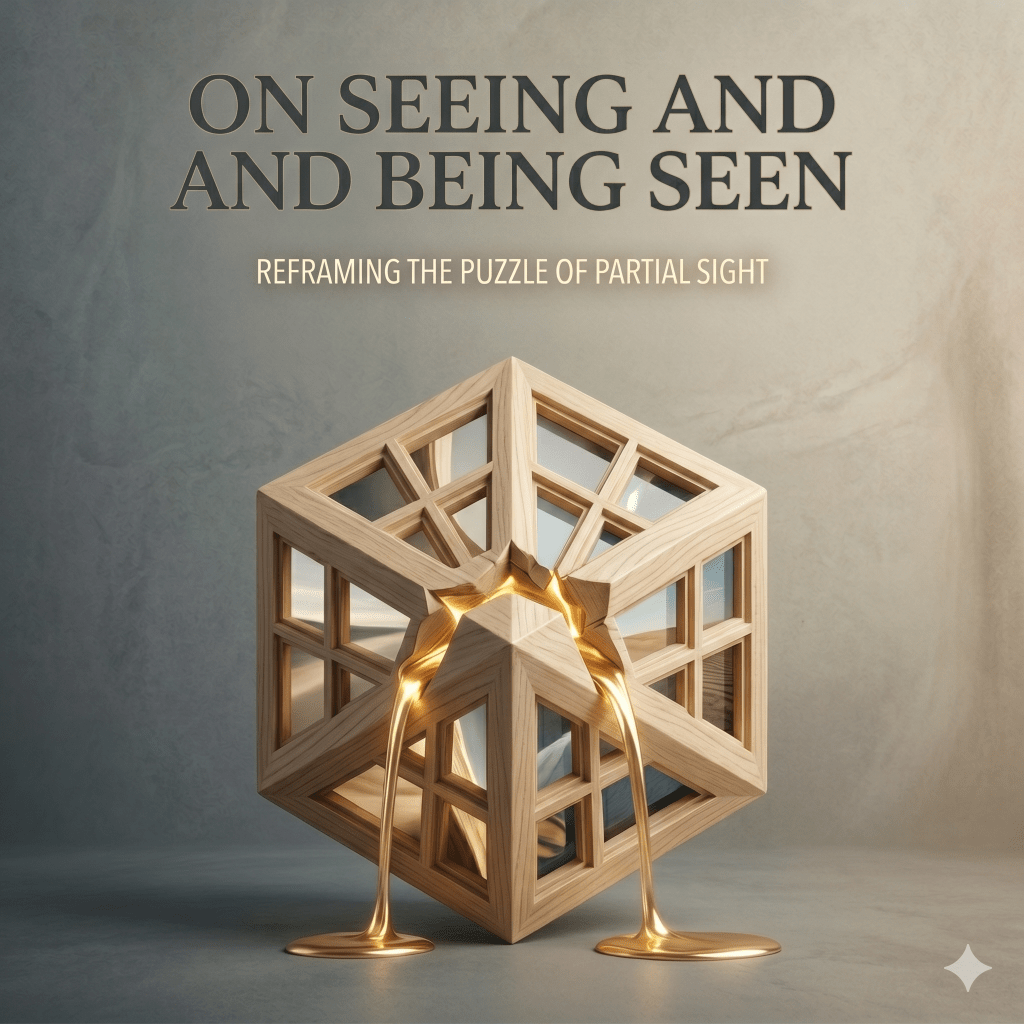
On Seeing and Being Seen
The Prism
We are each known only in part, and we know others only in part. It is a prism of sorts: we catch glimpses of one another, refracted at angles, never the whole light at once. Some of what we show is intentional, the face we curate, the version we want others to see. Some of it is wholly unintentional, shaped by how others have come to know us over time, by the environment that has formed us, by the pressures and tiredness of a given day.
This is not a failure of attention or of love. It is the ordinary architecture of human relationships. And nowhere is it more striking than between parents and their children.
The Window Each Relationship Builds
The trouble is that no two people ever see another person through the same window. Every relationship builds its own particular vantage point over time, and from that vantage point we see what the relationship calls forth. A wife sees her husband one way; his boss sees him another; his best friend sees a third. None of them are wrong. None of them are seeing the whole.
I have spent much of my professional life teaching this in the language of brand strategy. A brand does not exist in the marketer’s head; it exists in the mind of the consumer. What the company believes itself to be is almost beside the point; what matters is the picture the audience has assembled. The same is true of people. Each of us lives in the minds of the people who know us as a picture they have assembled out of what they have seen, what they have assumed, and the lens of the relationship they have with us. We do not get to dictate that picture. We can only offer what we offer, and trust the relationship to widen, over time, what comes into view.
This is the basic puzzle. Each of us is partially seen by everyone in our lives, and we, in turn, see them only partially. The window the relationship has built only opens onto so much.
Two Versions of the Same Person
This is the part I think about most, and it is where I want to spend some time, because it sits close to the question you have been wrestling with.
I see my son one way. I see the light and the love in him, the smart, caring, supportive, charming person who warms my heart. I also see the unfiltered moments: the snarky comment, the moody silence, the deliberate closing of the door between us. Meanwhile, the people who encounter him outside the house often describe someone different. Gracious. Considerate. Easy to be around.
The contrast raises an uncomfortable question. Which version is the “true” one?
Here is what I have come to believe: both are. Neither is a lie, and neither is the whole story.
The home is the place where the filter comes off. That is how home is supposed to work. The world outside requires us to perform a certain version of ourselves: pleasant, composed, gracious. We do it because the world demands it, and over time, we get good at it. Home is supposed to be the place we do not have to. The fact that a child can rest into his less-curated self at home is, in a real sense, a gift. It means home is doing what home is meant to do.
But the gift does not dissolve the puzzle for the parent who sees the unguarded version. The parent is forced to integrate two pictures of the same person, the gracious public self and the rougher private self, and the integration is not easy. The temptation is to declare one version “real” and the other a performance. Neither is.
The better question is not “which one is true” but “which one is being called forth, and by what?” The school version is true. The home version is true. They are different faces of the same person, called forth by different settings, different audiences, different expectations. A teenager, especially, is still figuring out which faces belong to him at all, and the differences between settings can feel exaggerated because the teenage years exaggerate everything.
If you find yourself with one picture of your son at home and a different one from teachers, coaches, or friends, please do not take that as evidence that one of you is wrong about him. It is much more likely that you are each seeing a true face, and that the full person includes both. The work, painful as it is, is to hold them together without forcing them into a single picture.
A Move Worth Learning
In my mediation work, I have come to think of one discipline as the master move. I call it frame-stepping.
People in conflict almost always arrive at the table convinced their own view of the situation is just the way things are, and the other party’s view is a distortion or a manipulation. The first work of mediation is helping each side notice that they have a view at all, that what they have been treating as “the facts” is actually “the facts as I am organizing them through my particular window.” Once they can see that, they can do the second move: step, briefly and provisionally, into the other person’s window. Not to agree with what is there. Not to abandon their own. Just to enter long enough to see what the other person is seeing.
This same move applies at the kitchen table. The parent who wants to understand the contradiction between the home self and the public self can put it into practice. What does my son’s day look like from his vantage? What is he managing that I am not seeing? What is the school version costing him by the time he gets home? What is the home version protecting him from having to maintain?
You will not get full answers to these questions. But asking them, even silently, even without him knowing you are asking, softens the picture. The unfiltered version starts to make more sense. It is the version of him that has nowhere else to land.
The mediator’s discipline at home: stay anchored in your own view, but step into his often enough to remember that the view from where he stands is also real.
Why This Lands Harder on Parents
The parent-child relationship is a particularly intense version of partial seeing, for three reasons.
First, the role was set before anyone could see it. From the moment your child was aware of you, you were a parent. There was no earlier phase in which they encountered you as a peer, a colleague, a stranger. The window through which the relationship looks was built before he had any capacity to examine it, making it unusually durable. In general, we are least able to question the windows we received earliest.
Second, the capacity to see a parent as a full person comes late. For most of childhood, a parent is more a function than a person, the source of food, safety, comfort, discipline, and guidance. Even in late adolescence and early adulthood, it is rare for a child to fully grasp that the parent is also a person with their own inner life, struggles, and continuing development. This is not a failure of the child. It is the structural condition of being a child.
Third, parents tend to collude, without thinking, in keeping their other selves invisible. We do not want our children to carry the weight of our work anxieties, our doubts, or our hard days. We curate what they see, often appropriately. But the result is that the curated version becomes the only version they see, and the window closes around it.
So when your son sees you in a particular way, much of what he sees is being shaped by structural realities he is not choosing, and you are not either. None of it is a comment on the kind of mother you are. It is just the shape this relationship is built to take.
A Few Things to Hold
If you are in the middle of this (the puzzle of seeing your son in a way that does not quite match what others describe, the ache of wondering which version is real, the weight of being known by him in a partial way), here are a few things I have found worth holding.
Both versions are him. Try to resist the temptation to choose one over the other. He is the gracious version others see, and he is the harder version you sometimes see at home. The fact that you get the unfiltered version is part of what home is for. It does not mean home has gone wrong. It means he trusts that home will hold him, even when he is not at his best. That trust is something you have built.
Do not campaign. If you sense your child does not see you the way you wish they would, the worst thing you can do is try to correct the record by dropping accomplishments into conversation or insisting on being seen more fully. Children, especially teenagers, harden against that kind of pressure. The frame widens on their timing and not yours. Be available when the door opens (a question at dinner, a moment of vulnerability, a request for advice that reaches past the day-to-day), and walk through it gently, offering what is asked for and not much more.
Locate yourself somewhere other than your son’s view of you. This is harder than it sounds. The relationships we have with our children are so weight-bearing that it is easy to let their perception of us become load-bearing as well. It cannot be. No single relationship, even the most precious, can carry the whole weight of who you are. Your sense of self has to be anchored somewhere else, in faith, in your other vocations, in the people who do see you whole. The eyes of a teenager cannot be the ground of your identity, even if they are some of the eyes you most want to be seen by.
Forgive daily. When your child treats your experience as irrelevant, dismisses your knowledge as outdated, or rolls his eyes at your hard-won convictions, the urge to take offense is natural. In most cases, it is also developmentally appropriate. Children, especially in adolescence, are doing the work of separating from us, and the slights are usually less about you than about that work. Forgive quickly. Keep the door open from your side, even when the door from his is temporarily closed.
Honor the role you are actually in. Being “just Mom” is not a lesser thing. For most of us, it is one of the most consequential roles we will ever hold. The same impulse that makes us long to be seen in our other identities can, if we are not careful, lead us to undervalue the identity our child does see. Do not let the longing for fuller recognition pull you away from the work that is actually in front of you.
Trust the long arc. The son of fifteen who cannot see you in your fullness is not the son of thirty-five who often can. The frame widens with time, with experience, and especially with his own encounter with the kinds of life you have already lived through. Patience here is not passivity. It is faith that the frame is not the final word.
Being Already Known
I want to end with the thing that has come to matter most to me, the part that finally makes the rest workable.
The longing to be fully seen is one of the deepest longings of the human heart. Some of us spend many years trying to satisfy it with the people closest to us: our children, our spouses, our parents, our closest friends. And we find, eventually, that no human relationship can carry that weight. They love us. They see us as well as they can. But they see us partially, the way we see them partially, and the longing to be known in full is not finally something a person can give us. Whatever our spouses, children, colleagues, and friends can see, the One whose vision matters most already knows us fully, and still loves us.
This is the anchor. It does not dissolve the longing, but it relocates it. The partial sight of those who love us is not the verdict on who we are. It is just the partial sight of those who love us, real, precious, and never the whole story. The verdict has already been spoken by a Father who sees the whole, and who has run to meet us anyway.
The roles we inhabit (parent, friend, professional, neighbor) are not costumes hiding a “real” self underneath. They are places where God’s hand is at work in the world. The mother who shows up to her son day after day, even when she feels unseen by him, is the form God’s love takes in that household, on that evening, for that child. The role is partial because it must be. But the partiality is not a failure. It is the shape of love embodied in time.
A Closing Word
The work continues. The window through which your son sees you will widen, or it will not, and the puzzle of two versions of him will resolve itself or not, over the long arc of a relationship that has many more chapters in it. What you have today (the love, the wear, the longing to be seen, and the longing to see clearly) is not the final word. It is a stop along a road.

 Life Vocations
Leave a comment