
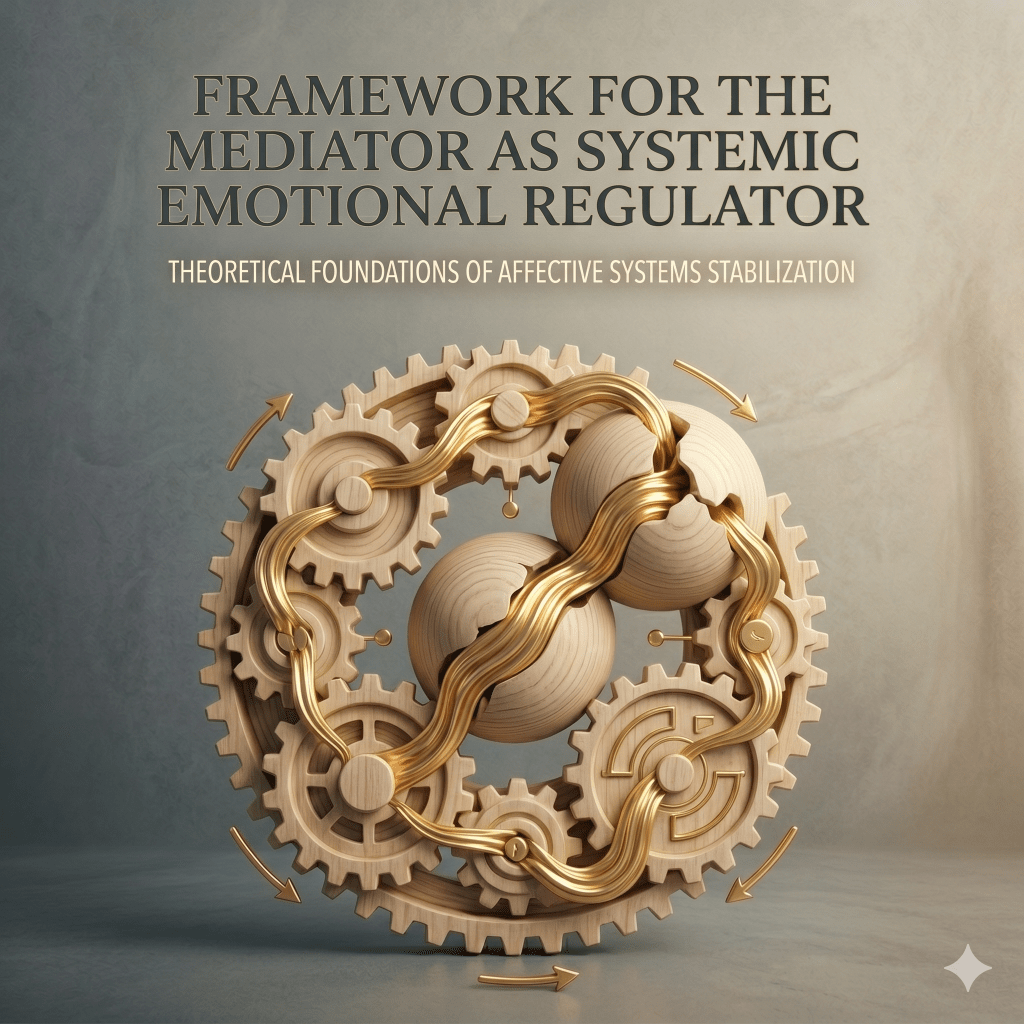
The Room Has a Mood, and You Are Not Above It
By Bryan D. Stafford
Picture a mediation that is going well. Forty-five minutes in, two people who could not be in the same building a month ago are leaning over a draft, trading language, inching toward a deal on an employment dispute that has hung over both their lives for two years. It is working. You can feel it working.
Then one of them says something true. Not cruel, not loud, just flat. A plain observation delivered with a face that gives nothing away. The other person hears that flatness as contempt. And in about ninety seconds, the whole thing comes apart. Both of them abandon the draft and start relitigating a comment from two years ago. The mediator, who was trained well, does the sensible thing and steers the conversation back to the table. Three times. Three times it snaps right back to the old wound.
The session ends with no agreement. Afterward, the mediator reads the transcript and cannot find the moment where it went wrong. There is no smoking gun. The words on the page look reasonable. So what happened?
Here is my answer, and it is the heart of everything I want to tell you. The room had developed a mood of its own. Not a metaphor for the sum of two grumpy people. An actual coordinated emotional state, held in place by the bodies in the room and the stories they were telling themselves, that the parties were caught inside rather than steering. The flat remark did not cause the blowup. It was the match. The fuel had been stacked the whole time. And until the room itself settled, no clever return to interests was going to hold, because you cannot reason with a system that has stopped being able to reason.
I call this work affective systems stabilization, which is a mouthful, so let me translate it. Before people can think, the emotional weather has to be survivable. The mediator’s first and most important job is not to manage positions or float proposals. It is to regulate the emotional system in the room so that everything else becomes possible. Settlement is not the work. Settlement is what happens downstream of the work.
Why we keep missing it
If you have spent any time in conflict resolution, you know the field has not exactly ignored emotion. We have decades of good thinking about it. The classic interest-based approach, the one most of us learned from Fisher, Ury, and Patton, treats emotion as static on the line. Acknowledge it, normalize it, then get back to the interests underneath. Useful advice. The transformative tradition went the other direction and said the emotional shifts are the point, that helping people recover a sense of agency and the ability to see each other as human is the actual product. Also true. Other thinkers gave us a vocabulary for the core concerns that drive people in a fight, things like appreciation, autonomy, and status.
Each of these gave us something real. But notice what they share. They all locate emotion inside a person, or between two people. The negotiator has feelings. The party brings concerns. The relationship carries history. None of them quite asks whether the room, the small group that forms the moment a mediator sits down with people in conflict, grows an emotional life that is bigger than the people in it.
And the research outside our field has been quietly insisting that it does. Sigal Barsade’s work on emotional contagion showed that moods spread through a group below conscious awareness and reshape how people cooperate or clash, often without anyone noticing the transfer happen. A meta-analysis of sixty-four negotiation studies confirmed that emotional expressions move outcomes in predictable ways. Researchers studying collective emotion have catalogued distinct patterns by which a group’s feeling amplifies, converges, polarizes, and cascades, none of which you can predict by adding up the individuals. The emotion in a conflict is not happening only in two skulls. Some of it is happening in the space between them. That space is what I think we have been failing to treat as real.
Borrowing a good idea from a hard place
The phrase I use comes from trauma therapy, and I want to be careful about the borrowing, because it can sound grander than I mean it.
In trauma work, stabilization is a phase. Before a clinician helps someone process the worst thing that happened to them, they first help that person’s nervous system find enough steadiness to tolerate the material without drowning in it. Skip that phase and you do harm. The insight is simple and a little humbling. A dysregulated system cannot do the very work that would help it. Stabilization is not the warm-up before the real work. It is the work that makes the rest of the work possible.
Now, a mediator is not a therapist, and I will say that more than once because it matters. We do not diagnose anyone. We do not treat trauma. We do not try to heal the parties, and we are not qualified to. What translates is not the clinical role. It is the logic. Just as you cannot do trauma processing with someone whose system is in free fall, you cannot do interest-based bargaining with a room whose emotional system has come unglued. The mediator who pushes for substance before settling the room is making the same category of mistake as the clinician who rushes the hard material. The goal is humbler than therapy. We stabilize so the mediation can do the job it was hired to do. That is all. But that is a lot.
Four old traditions, one new room
So how does a room develop a mood, and what do you actually do about it? I lean on four bodies of work that almost never appear in the same paragraph, let alone the same theory. Each one supplies something the others cannot.
The first is Murray Bowen’s family systems theory, which gives us the foundation. Bowen argued that a family is not a pile of individuals who each happen to have feelings. It is an emotional system, where anxiety and steadiness move between people in patterns, and where how any one person functions depends on their position in the whole. A mediation room is not a family. But it is a small group of humans wrestling with emotionally loaded material, and the same logic applies. The room can carry anxiety the way a family does.
Bowen also handed us the single most useful idea I know for this work, which he called differentiation of self. A well-differentiated person can stay close to intense emotion without being swallowed by it. They can think clearly while feeling deeply, hold a principle while under pressure, stay connected without going reactive. A poorly differentiated person fuses with whatever is around them. Their thoughts get colonized by their feelings, and their feelings get colonized by the room. Edwin Friedman later carried this into leadership and gave it a phrase I keep on a sticky note in my head: the leader’s job is to be a non-anxious presence. The leader who catches the system’s anxiety amplifies it. The one who stays steady becomes the fixed point everyone else can reorganize around.
The second tradition is group-as-a-whole psychology, which tells us what these emotional systems look like when they wobble. Wilfred Bion noticed that groups slip out of doing real work and into shared, unspoken emotional postures. They get dependent and wait for someone to rescue them. They go into fight or flight and start swinging or bolting for the exit. They pair off in a hopeful little alliance that promises a solution and quietly avoids the actual problem. If you have mediated for a while, you have seen all three, probably this month. Bion just gives you names for the moment the room “goes somewhere it should not.”
The third tradition is the body. Affective neuroscience has spent decades dismantling the old idea that reason and emotion are opponents. Antonio Damasio showed that feeling is woven into thinking, not opposed to it, and that when the emotional system is overwhelmed, the cognitive tools we need most, working memory, perspective-taking, flexible problem-solving, measurably degrade. This is the biology behind a claim that otherwise sounds like a slogan. You cannot reason with a dysregulated room because the reasoning equipment is temporarily offline.
The same field tells us how feeling moves between bodies. There is now a solid and growing literature on physiological synchrony, the way our heart rates, breathing, and stress responses quietly line up when we are in a room together. A recent synthesis in Nature Reviews Psychology found this coordination is common, measurable, and tied to how relationships and tasks turn out. Concepts from trauma-informed care, like Dan Siegel’s window of tolerance, describe the band of arousal inside which a person can still think and engage. Push someone above it or below it and the window slams shut. The practical punchline is bracing. The mediator’s own body is part of the instrument. A mediator breathing fast, jaw tight, voice rising to match the room is feeding the dysregulation. A mediator who is genuinely settled is offering the room a calmer rhythm to fall into step with.
The fourth tradition is the most hands-on. Marsha Linehan’s Dialectical Behavior Therapy was built to help people with overwhelming emotions, and it includes the most carefully developed, well-tested map of emotion-regulation skills we have. I am not suggesting mediators run DBT on their clients. I am borrowing its sequence, the way it teaches you to observe an emotion, name it precisely, check whether it fits the facts, and choose a response. That sequence happens to be exactly what good mediators already do on instinct. Naming it just makes it teachable.
What you actually do, in the room, in real time
Theory is comforting, but at some point the room is on fire and you have to do something. So here is the spine of it, a four-stage loop you run again and again across a session. If you forget everything else, keep this.
Read the signs. Long before the words escalate, the bodies do. A flush, a shift in breathing, a posture that tightens, a hand that closes, eye contact that breaks. These are the early-warning system, and they usually show up seconds, sometimes minutes, before the sentence that blows things up. The mediator who reads the room through its body intervenes earlier and more gently than the one who waits for the shouting.
Find what is driving it. Here is a distinction that quietly saves mediations. The event is not the cause. The interpretation is. A neutral question can land as an accusation. A procedural pause can land as abandonment. The same eight words can be concern or contempt depending entirely on the story the listener is telling. If you treat the event as the problem, you will keep relitigating events. The driver is almost always the meaning someone made.
Name the emotion, precisely. Not “upset.” Not “frustrated.” There is real research, under the unlovely name of emotion granularity, showing that people who can tell their feelings apart, who know the difference between disappointment and grief, or irritation and contempt, regulate better and decide better under stress. Precision is not pedantry. It is regulatory. The moment you accurately say “that sounds more like shame than anger,” you have changed the problem the room is trying to solve, because shame and anger want completely different things. Contempt, by the way, is not strong anger. It is its own beast, and it corrodes a relationship in a way plain anger does not. Knowing the difference tells you how worried to be.
Course correct. Once you know what you are dealing with, you choose. If the feeling does not fit the facts, the move is to gently widen the lens and invite a second look. If the feeling fits the facts but acting on it would torch the room, you validate it as legitimate and channel its energy somewhere useful. If the facts themselves are the problem, you go back to honest problem-solving. Then you start the loop over, because a settled room can come apart again in an instant, and stabilization is a condition you maintain, not a box you check.
Underneath all four sits a stage I think of as stage zero, and it is the one nobody trains you for. It is you. Your own steadiness, cultivated long before anyone walks in. Bowen’s research tradition, summarized in a recent review of nearly three hundred studies, links higher differentiation to better functioning under stress. The psychotherapy literature has found for years that the practitioner’s own regulation is among the most reliable predictors of how things turn out. A reactive mediator running a flawless technique fails. A steady mediator running a clumsy one often succeeds, because the steadiness is the thing that lets any technique work at all. The order of operations in most of our training, technique first and the self as an afterthought, has it exactly backward.
Why this travels well beyond mediation
I write for mediators, but I would be hiding the ball if I pretended this only matters in a mediation room. The room is just a clean, high-stakes version of something you already live inside.
A manager walks into a tense team meeting and decides to “just stick to the agenda.” The agenda is not the problem. The room has a mood, and the manager either steadies it or feeds it. A parent tries to reason a flooded teenager back to calm and gets nowhere, because the reasoning equipment is offline and what the kid needs first is a slower heartbeat to borrow. A couple has the same fight for the ninth time and keeps arguing about the dishes, when the dishes were never the driver. The driver was what the dishes meant.
In every one of these, the same quiet truth is operating. The most regulated person in the room is not the most powerful or the loudest. It is the one who can stay connected without catching the fire. That person becomes the reference point. Not by force. By steadiness. You have almost certainly been rescued by such a person, and you have almost certainly, on a worse day, been the one who threw gasoline. I have been both, sometimes in the same afternoon.
So the practical takeaway is smaller and harder than a technique. Before you try to fix the content of a hard conversation, ask what state the room is in, and ask honestly what state you are in, because you are not standing above the weather. You are part of it. Steady yourself first. Slow down before you speak. Name what is actually happening before you try to solve it. The fix you were reaching for will land a great deal better once the room can hear it.
Where this is honest about its limits
I would not trust this if I sold it as finished, so I will not. This is a theory, built by braiding together strong work from other fields, and the direct studies in actual mediation rooms still need to be done. Some of the constructs come from individualist, broadly Western traditions and will need real adaptation elsewhere. There are rooms where this does not simply apply, especially where there is abuse or severe power imbalance, and where co-regulation between the parties is itself part of the harm. And it is not therapy. A mediator who tries to manage a genuine mental health crisis with these tools is making a serious mistake, and part of the discipline is knowing when to pause, refer, or stop.
But here is what I am confident about. Experienced mediators have been doing a version of this for years without a name for it. They walk into a room, feel it tip, and somehow set it right, and afterward they call it intuition because we never gave them better words. This is my attempt at better words. Not to invent what good practitioners do, but to make it visible, teachable, and testable, so the next generation does not have to wait twenty years and a few hundred ruined sessions to learn it by feel.
The mediation I opened with did not fail because the mediator lacked skill. It failed because her training taught her to watch the words and the interests, and not the weather. The room changed, and she had no name for what it changed into, so she kept reaching for the table while the floor was moving. Give her the language, and she sees it. Give her the steadiness, and she can stand in it. That, in the end, is the whole argument. Manage the room’s emotional life first, your own included, and the agreement you were chasing tends to come and find you.
The full academic paper this article is based on, “Mediation as Affective Systems Stabilization: A Theoretical Framework for the Mediator as Systemic Emotional Regulator,” is available at the end of this blog entry.
 Life Vocations
Leave a comment