
Notebook Recap Podcast
The Second Suffering
Why the argument with what has already happened often costs more than the wound itself.
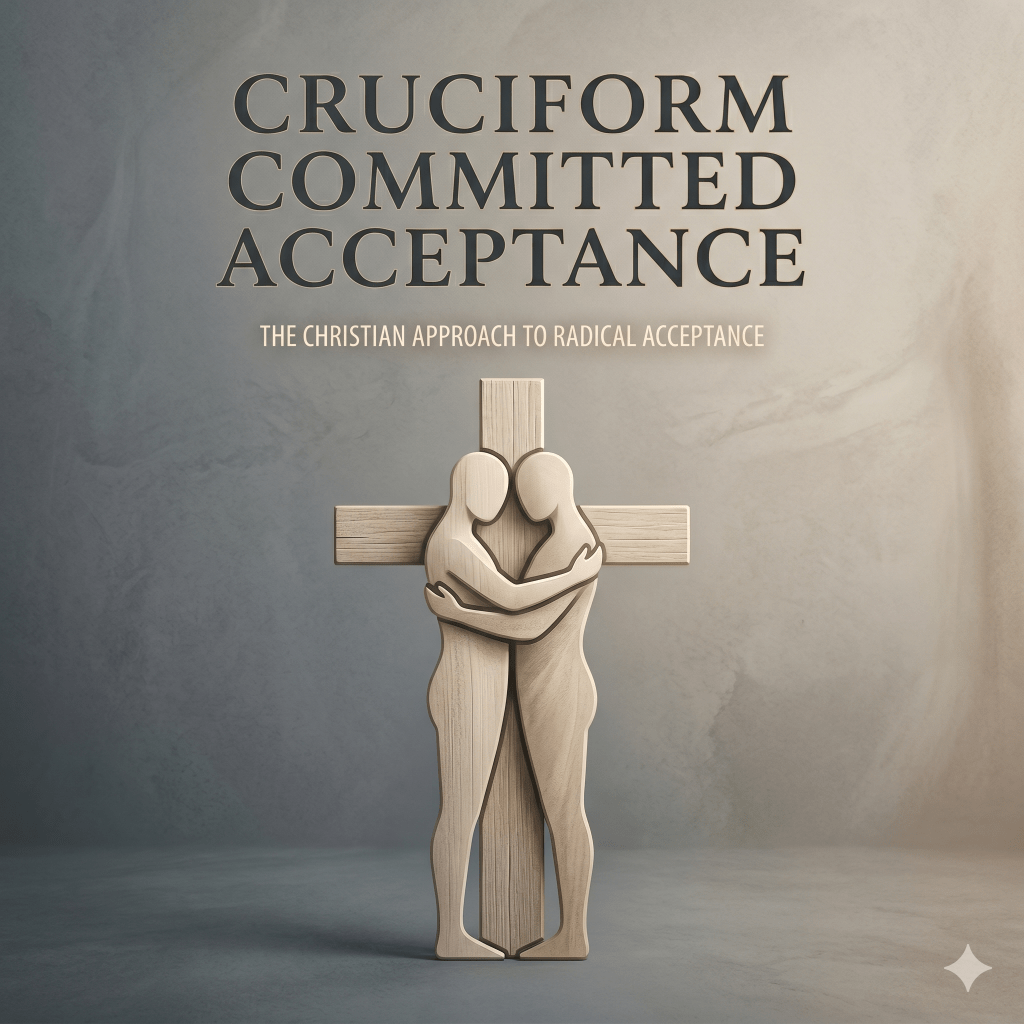
Cruciform acceptance: not a wound explained away, but a wound carried honestly, the way the cross does not erase suffering but bears it. And this, this, is my goal. And I pray every day for the strength not only to accept this but to remain in it.
– Bryan Stafford
For years, I could not say the sentence plainly: my father took his own life.
Six words. Subject, verb, object. A child could diagram it. I could not say it. I could talk around it with the fluency of a man giving directions past a road he refuses to drive down. He passed. We lost him. There was a tragedy in our family. Anything but the sentence itself, standing in the open with nothing draped over it.
And when the sentence did force its way in, it never arrived alone. It came escorted. It should not have happened. It did not have to happen. Surely there was something I should have seen. The protest was so punctual, so faithful in its attendance, that for years I mistook it for part of the fact. I thought that was simply what his death was: a wound with an argument stapled to it.
I have spent the last several years writing a book about what I eventually learned inside that argument — a book called Cruciform Acceptance, about what it means to receive a reality you cannot change, before God, without ever once calling the evil good. The book makes a larger claim than this essay can hold, and I am not going to try to hold it here. I want to walk into just one room of it: the one where I lost the most years. Because before I could understand anything about acceptance, I had to discover that I was carrying two pains, not one — and that the second was of my own manufacture.
The court that had already adjourned
For me, the shape of refusal was a courtroom.
For a long time, I treated my father’s death as a verdict I could appeal. Not deliberately — no one drafts these pleadings on purpose — but that was the posture. Somewhere, a judgment had been entered against my family, against my father, against me, and I conducted myself like counsel who had lost on a technicality. I kept filing motions with a court that had already adjourned.
Motions to reconsider: the counterfactuals, each one a brief arguing that the outcome should be set aside because a better one had been available. Discovery: the endless rereading of the final chapter of his life, the subpoena of every memory that might contain the overlooked exhibit. And cross-examination — of the past itself. I put the last months of his life on the stand and went at them again and again, certain that under enough pressure they would break and confess something new.
Here is what I learned, slowly, at prices I will not itemize. The past does not yield to cross-examination. You cannot trap it in a contradiction. It has no new testimony to give. Ask it a thousand times, and it answers with a patience that feels like cruelty: this is what happened. The witness is not hostile. The witness is simply finished.
Two pains, one seam
There were two pains, and it took me years to find the seam between them.
The first was grief. It was real, it was proportionate, and it would have come no matter what I did. Love had been severed; grief is what severed love feels like. Grief is the bill that love pays, and there is no negotiating the amount. There was never a version of this story in which that pain was optional, and I would not want the version where there was.
The second pain was different. It did not come from the loss. It came from the refusal of the loss — from the protest, the counterfactuals, the litigation. It was manufactured daily, by me, in the courtroom I could not leave. And here is what I most need you to hear: the second pain was not smaller than the first. In some seasons, it was larger. The suffering of a mind insisting that reality submit to its objection is not a footnote to grief. For many of us, it becomes the main text.
That is the strange arithmetic this essay is about. Pain is one quantity, and the war against pain’s existence is another, and the second is often the larger of the two. The appeals cost more than the grief did. They billed me in sleep, in presence, in prayers I could not finish. They took hours that belonged to the living and spent them on a proceeding that could not be won. That is the cruelty of relitigating the unalterable: it does not merely fail. It collects fees while failing.
Therapists have a name for laying down that war. Marsha Linehan, who built dialectical behavior therapy for people whose emotional pain ran hotter than ordinary treatment could touch, called the skill radical acceptance, and its central claim can be said in one line — the clearest piece of teaching I know. Pain plus nonacceptance produces suffering. Pain accepted is, in a strange way, just pain. The event delivers its pain once. Refusal delivers it daily.
You do not need a clinician to find the seam. You need one unhurried hour with a hard question: how much of what I carry is the loss, and how much is the argument?
The anatomy of refusal
Refusal has an anatomy, and learning it by sight changes what you see everywhere.
The first move is the counterfactual. If only. If only I had called that week. If only we had left earlier, chosen the other doctor, said yes instead of no. The counterfactual feels like thinking, but it is not thinking. It is time travel on foot. The mind walks back to the fork in the road and stands there, trying doors that no longer exist. I practiced this with a scholar’s discipline — rereading the same final chapter, scanning for the place where the story might have turned, as if enough scrutiny could revise an outcome already fixed. That is the secret faith at the bottom of refusal: the belief that attention is a solvent. Study the sealed thing long enough, and it will open. It will not. I can save you the years I spent proving it. It will not.
The second move is self-accusation. Surely there was something I should have seen. This one wears the costume of moral seriousness, which is why it is so hard to take off. But listen to what it actually claims. It claims the outcome was in your hands — and therefore, somewhere back down the road, still is. Self-blame keeps the case open. It is often grief refusing its own helplessness, because even a guilty verdict against yourself feels better than a world in which such things simply happen and no one could have stopped them.
The third move is bargaining with the past. We know about bargaining with the future; every foxhole prayer is one. Bargaining with the past is stranger and more common. We offer it our sleep. We offer it our appetite, our attention, our years. We pay and pay, as though the past kept accounts and might, for a sufficient sum, agree to reopen the file.
Three moves, one conviction: the fact is still negotiable. The last chapter can still be rewritten. As long as that engine runs, you are not yet grieving what happened. You are negotiating with it.
In the book I write about a mother I call Marta — a composite, like everyone in its pages, of many people and no one. A pickup ran a stop sign and struck the passenger side of her car; her son lived, and he walks now with a hitch in his right leg that may be permanent. The police report is unambiguous: she had the right of way; there was nothing she could have done. She can recite it. And every night, after the house goes quiet, her mind drives back to that intersection. If she had left the gym four minutes earlier. If she had taken the other road. She is not remembering. She is searching — for the version where she turns her head half a second sooner.
Marta is exhausted in a way sleep does not touch, and her exhaustion has a precise cause. It is not the accident; the accident is over. It is the daily, hourly labor of fighting a thing that has already happened. Fighting reality is work. It keeps hours. It draws strength that would otherwise go to the living. And it produces nothing, because its object is fixed and its motions are pantomime.
Love in its last available uniform
Here is the part that undid me, and the part I suspect will undo you: the refusal is not foolishness, and it is not weakness. It is love with nowhere to go.
Ask Marta why she cannot stop the replay and she will tell you, quietly, because she knows how it sounds: stopping feels wrong. Like going off duty. Like agreeing to her son’s leg. As long as she keeps working the intersection, she is still doing something for him. The replay feels like the last shift of a rescue that never happened.
I knew that shift. No one had assigned me my litigation. There was no client demanding I continue, no date on any docket. I had volunteered, and I kept volunteering, because closing the file felt like a betrayal of the man whose case it was. As long as I was arguing, some part of the matter seemed still pending — still open, still undecided, still, in a way I could not have admitted out loud, alive. The appeal was never really about winning. It was about not letting the court’s silence be the last word.
This is why the second suffering is so hard to lay down. Something faithful sits at the bottom of the sleeplessness. Refusal is very often devotion that has taken the only form left to it: an appeal. Which means no one is helped by being scolded out of it — and it also means the exit, when it comes, has to honor what the refusal was protecting.
What quitting the case does not mean
I know what the proposal sounds like from the outside, because everything in me stood up against it too. Accept sounds like approve. It sounds like signing at the bottom of the page — like stipulating that the outcome was tolerable, that the objection is withdrawn, that the court was right. If that were what acceptance meant, I would tell you to refuse it.
It is not what acceptance means. The courtroom itself taught me the difference. To accept that a verdict was entered is not to call the verdict just. Quitting the litigation is not endorsing the judgment. A family can acknowledge that the court ruled against them and go to their graves believing the ruling unjust. What they cannot do — not without handing the ruling their whole lives — is proceed as though no ruling occurred. I acknowledged that the ruling stood while believing, to this day, that what happened should never have happened. Both of those truths live in me now, side by side, and neither cancels the other. The fact is a fact. The wrong is still a wrong.
Nor is acceptance passivity — this is the one that surprises people. We assume the fighter is the active one and the acceptor has gone limp. It is nearly the reverse. Refusal, for all its fury, is strangely passive: it stands at the gate of the past demanding entry while the present goes untended. It was not refusal that sat through Marta’s son’s physical therapy, learned the exercises, and badgered the insurance company. Refusal was busy at the intersection. Acceptance was in the waiting room.
And it is not a feeling, achieved once. The refusing mind keeps wandering back to the gate to lodge its complaint, and you turn it — again, and again. Nobody signs a single armistice. The war resumes at two in the morning, and you end it again at 2:01. There is mercy hidden in that: if acceptance is a repeated act rather than an attained state, then this morning’s relapse into protest is not the loss of the war. It is one more turn to make.
One warning, because no one gave it to me. When you first lay the argument down — even for an afternoon — expect a strange stillness where the protest used to stand. You may find that you miss it. The argument was terrible company, but it was company; it filled the room the loss had emptied. The silence after the courtroom is not peace, not yet. It is only the sound of a fact, finally allowed to be a fact. Peace, if it comes, comes later, and by another road.
The question the courtroom leaves open
What changed in me was not that the loss became acceptable. It did not, and it never will. What changed was that I stopped demanding it be otherwise. I let the fact be a fact. Not a good fact. Not a meaningful fact — not yet, not for a long time. Just a fact: a thing that had actually happened and was therefore no longer subject to revision.
But a fact accepted is not the end of the matter, and this is where the room I have shown you opens onto the rest of the house. Acceptance held as a bare fact can curdle into a cold resignation. You can accept a death the way you accept the weather — a stoic shrug before a meaningless event — and that is its own kind of death. It was not where I landed, and the reason it was not is the reason I wrote the book. There is an old line of Luther’s that the whole book lives inside: a theologian of glory calls evil good and good evil; a theologian of the cross calls the thing what it actually is. The book argues that Christian acceptance is not resignation at all — that telling the unvarnished truth about your wound is not the thing keeping God away, and that a fact released is not released into a void. But those are arguments for another day, and they deserve the length I have given them there.
Months into her own work, Marta was asked what had changed. She put it better than I could: “The accident finally stopped happening every day. Now it only happened once.”
You may be holding a sentence of your own that you cannot say plainly. He is gone. She is not coming back. I am sick, and I am not getting better. It happened. I am not going to tell you to say it today. The court is adjourned either way. But it may be worth one unhurried hour to ask how much of what you carry is the loss, and how much is the argument — and what the argument has cost you in the last year.
Let the fact be a fact. Then come and see whose hands are under it.
Keywords: radical acceptance, dialectical behavior therapy, acceptance and commitment therapy, theology of the cross, Confessional Lutheran theology, faith-integrated counseling


Response
[…] books straight but from a peace that is itself a kind of justice. Or perhaps something closer to a cruciform acceptance (a concept I have explored): not a wound explained away, but a wound carried honestly, the way the […]
LikeLike